

Substack General Archive
https://operajupiter.substack.com/archive?sort=new
Driving the Labyrinth Archive with Posts in Reverse Chronological Order. The most recent, the Montreal-Maine post, was challenging to write because of the time difference between now when I am editing and posting it and 2014 when I originally wrote it. I am also limiting my proof-reading because this is meant as ephemeral writing, a prosody-like calligraphy, maybe not “post what you get on the first try” but one edit and one quick proof only. I can’t explain why I missed some of the most interesting shots and picked some of the least interesting things to shoot except that maybe the numbers on the photographs suggest that many are missing (like the interaction between the dogs and the squirrel). I think I deleted too much stuff randomly when I got warnings about lack of remaining computer space over the years.
Montreal
Montreal was our last locale on the labyrinth from Berkeley, California, to Portland, Maine. Since we were under no immediate pressure to complete the trip and had the use of a friend’s apartment for a week (after sharing it the first night), we decided to stay in Montreal for five days. When we arrived there on Sunday evening, our agenda other than wandering around the city was to visit various friends: Mary Stark and her husband Jia-lin, Andrew Lugg, Jesse Ning and his son Angus, and Wayne Turiansky.
At the time, Mary was my archivist and literary executor, so we communicated by email on an ongoing basis. I “met” her initially in the mid-eighties after she read Planet Medicine and The Night Sky and sent me an old-fashioned letter. After a lapse of a couple of decades we reconnected in the era of the Internet and, when I heard about authors (Maxine Hong Kingston, I believe, was main one) losing whole manuscripts and their back-ups in the Oakland firestorm, and given the threat of a long-overdue earthquake on the Hayward fault rendering our house irreclaimable, I took to emailing her updated files of my work as I produced them and she archived them.
I met her and Jia-lin in person for the first time in 2006 in Montpelier, Vermont, roughly halfway between our location at that time. They drove down from Quebec and I came up from Connecticut while Lindy was attending her fortieth reunion at Smith. Then in 2010 before flying back to SFO, Lindy and I took a long route from Maine to Logan Airport in Boston, via Quebec City, Montreal, and Vermont, and stayed in a cottage that Mary’s family owned near their house in suburban Beaconsfield. That gave us a chance to visit her and Jia-lin for a few days while we explored Montreal.
That was not our first (or even second) visit to the city. We drove to Montreal numerous times between 1972 and 1977 when it was the closest metropolis to our home in Plainfield, Vermont; in fact, it was close enough for day trips. We even attended a Montreal Expos/New York Mets game at Parc Jarry sometime around 1973.
Andrew Lugg was a more recent migrant to Montreal. He and Lynne Cohen were among our closest friends in Ann Arbor during the late sixties. He is an academic philosopher, originally from England; she a museum-quality photographer. In fact, she was working in Quebec City on commission when we passed through there in 2010, so we got to reconnect with her and Andrew for the first time in decades, a visit I wrote about in my book The Bardo of Waking Life. They lived in Ottawa for most of their professional lives, both of them teaching at the University there; they moved to Montreal after Andrew’s retirement.
Lynne passed in May before we arrived after three-plus years of lung cancer, an ailment diagnosed not long after we saw them in Quebec. I was not sure that Andrew would even feel like visiting, having old memories stirred up by another couple with whom he and Lynne shared a 1960s past but not much since, especially so soon after his ordeal, but he encouraged us to visit after I sent a feeler from Toronto.
Jesse Ning was my most recent Montreal friend. I met Jesse the previous summer, along with his wife Lucy and son Angus, at the trailhead for Parkman Mountain in Acadia National Park. That day I had driven there with a plan only to hike the Parkman-Bald-Mountain loop, not much more than an hour’s climb and return. They planned a three-mountain loop that included Sargent, the second highest peak on the island at almost 1400 feet, an overall hike of more like five hours. At the trailhead, Jesse approached me, a stranger, for advice on their hiking itinerary, and, after we fell into easy conversation, I elected to walk the full loop of trails with them.
I never got clear during that hike, or even later that day when they came to our house to meet Lindy and for tea and dessert, exactly where they were born and raised or presently lived. Since they were Chinese and lived in Beijing, I assumed that they were Chinese nationals who had bought a second home in Montreal. While Angus was between junior and senior years at Brown then, majoring in philosophy and applied mathematics, I assumed that he was a Chinese rather than a Canadian student in the US. Lucy was an M.D. in Beijing, but she got her degree at UCSF in the Bay Area where the family lived for a while—Angus was born there. In truth, I learned in Montreal they were native Quebecois, Chinese Canadians who had evolved planetary citizens.
In the course of our 2013 hike, I discovered that Jesse was a wide-ranging entrepreneur specializing mainly in editorial ventures. Having been the publisher of the Chinese version of Elle as well as other big-market mainstream magazines, he was on the verge of launching broader ventures including books on health and other topics with a partner in Baltimore. During the hike he proclaimed an interest in our staying in touch with an eye toward possible business ventures together and, while at our house, he bought a number of my own books, for family members as well as himself. We exchanged some hello-goodbye emails during the year, but I did not expect to meet up him in person again anytime soon. Yet while Lindy and I were in Texas, Jesse (a reader of this travel journal) emailed to see if I was in Maine yet and, if so, whether we might get together to discuss Chinese rights for some of North Atlantic’s alternative-medicine titles. I wrote that we were in Austin but would soon be in Montreal. He was already there, working at his family’s hotel, a venture he hadn’t mentioned on our hike.
Wayne Turiansky was a poet living in Vermont during our time there teaching at Goddard (1972-1977). Lindy and I not only included him in the 400-page Vermont issue of Io but, after we started North Atlantic Books in 1974, initially publishing writers only on grants or by donations, his book Sand Cast became the fifth or sixth title in the series. Wayne’s short “long” poem had to do with an unrequited romance and a road trip across the country, the picture of the coed at stake gracing the cover.
Back in the seventies I learned that Wayne’s grandmother Lillian Brown owned Brown’s, the hotel in the Catskills geographically closest to my family’s resort and named similarly after the founding family. Though quite a bit smaller than Grossinger, Brown’s was part of its recreational, entrepreneurial, and ethnic gestalt—the boorishly epitomized Borscht Belt—and flourished and then faded in roughly the same three-quarter-century period under the same regional, economic, and cultural forces.
I lost touch with Wayne soon after we left Vermont, but I had recently found and friended him on Facebook. I had been searching for Io contributors in present time in order to ask their permission for their work to appear in a fiftieth-anniversary anthology scheduled for 2015. I never quite determined where Wayne lived these days, or where he had lived in recent years, Montreal or Vermont. It turned out to be both places: he had been commuting for a long time.
After Lindy and I exited 15 south from the Laurentians, we proceeded such a long way down St. Denis that we were sure that we had overshot Pine Avenue, the next landmark on our map. In fact, we should have been looking for the Avenue Des Pins, and luckily we caught the potential “lost in translation” sign in advance on the car GPS and made the right turn.
Thereafter St. Denis became our neighborhood and compass. We returned to it many times, to walk, to eat, to window-shop, to sightsee, and to get going in both the right and wrong directions, the latter more times than you would think possible in a mere five days.
Montreal is Francophone, and its underlying bilingual status has a subtle and profound effect on an Anglophone’s interactions with local habitants—bilingualism is deep-seated, a habitual state of mind. In all of Quebec, in fact, language carries cultural and political ballast, to the point being incendiary, as the province intends to keep its French heritage within a larger, mostly English-speaking nation on the border of an English-speaking, imperialistically Anglophile empire (as well as under the pressure of general international Anglicization). English has become the world’s de facto Esperanto, its corporate lingua franca.
Montreal has a notorious cadre of language police who go around town seeking illegal Yanqui drift and issuing criminal citations for English signs with words and even the verbal use of English by civic employees, shopkeepers, and other regular folks. At one extreme, linguistic vigilance is necessary to stem the flood of Anglicization; at the other it is fascistic to the point of a theater of the absurd, with people being fined and even threatened with jail time for trying to make themselves comprehensible to other human beings. [A Quebec-based friend notes, “It is not that draconian, only treated as such by the Anglo media. I have never heard of jail time.”]
For the record, any particular language is an arbitrary band within a broader spectrum of phonemes anyway, all of them (on Earth) originating from some Ur Indo-European/Sino-Tibetan babble that, along with all ancient dialects as well as animal call systems on the planet, originated in Noam Chomsky’s deep syntax—the neurological pathways and logic strings of the chordate, then mammalian, then primate brain. All terrestrial languages are finally variants of the same language, biologically and psycholinguistically, so why valorize or criminalize a particular melody? It’s all the same basic song. On the other hand, you would hardly want to relinquish the distinctive sounds of Stéphane Mallarmé and Edith Piaf under a deluge of corporate English. After all, French has a distinctive aesthetic beauty, soul depth, and meaning set. A semantic conundrum for sure.
We never encountered any reactionary blowback against English in Montreal (as we had on occasion in Quebec City four years earlier), but we did have to engage in a constant give-and-take while navigating a gamut of varying responses, most of them happily and graciously on both sides. They coalesced along the tension lines of our only speaking English in a French-preservation zone. People’s French instinctively held its ground as both the conversation-initiating and default tongue, even for English speakers because they had been daily sensitized to the ongoing cultural and political issue. At widely diverse skill thresholds of English, the speech of individuals flowed back and forth across an elusive line that separated us gringos from them, a line that was not tipped off by a given person’s dress, style, appearance, or mien. We got to experience a small sample of limitless variations on the theme of “English meets French” as well as “English meets Franco-English in a Français-speaking Zone.” Montreal residents had performed this delicate semantic dance for so long that they had developed diplomacies and linguistic traits that were, for the most part, subliminal yet honed to black-belt level. So, this was even true for English speakers in Montreal: two Anglophones initially had to acknowledge and discount that they were engaging verbally in a French-speaking zone before resorting to English.
My initial Franco-Anglais experience came very soon after arrival when, after helping to unload our items into the apartment, I tried to figure out where to park the car long-term. Streets signs were of course all in French. I understood from our hosts’ explanation that we faced multiple regulations: spots okay for people only with a numbered neighborhood sticker, spots okay except on street-sweeping days (Mercredi and Vendredi in our near vicinity), mirage spots not okay under any circumstances (and for no discernable reason), spots okay if you walk to the credit-card machine, register your parking-space number, and pay. It was unclear to me how they checked without printed coupons on the dashboard, but a friend later told me, “There is a central computer that has its eye on you.” Add to this the complication that cones were later placed around our quite legally parked car, turning much of the street into a sudden towaway zone for electrical work.
So , when our written instructions from Arnie (see the previous post) seemed to contradict my rough translation of the French signs, I stopped someone educated-looking, who turned out to speak very little English. While puzzling over the instructions with me, he finally concluded that I couldn’t park where I thought I could because I needed a numbered neighborhood sticker for the location. As I stood there pondering my remaining options, he marched all the way back from farther down the block not only to point to a small sector of spaces that did not require the sticker but to indicate the one that was available and to hold it while I hurried. Any tension I might have felt from “forcing” him to speak English was dispelled by this generous act.
The following morning, I went out for a walk in my the five-fingered shoes I wore periodically then. Steve Curtin, an osteopath in Maine, recommended them on the premise that they are therapeutic for spreading out toes and ameliorating, among other things, neuropathy. They make one feels as though he suddenly has ocelot paws and is about to take off after a rabbit. In my first quarter-block in these shoes I was stopped by a dapper man who began speaking French to me. Since Lindy and I had already been approached by two or three French-speaking panhandlers, my initial response was to disengage. He grokked at once that I didn’t understand him and switched to broken English, asking whether I liked the shoes (while pointing) because he was thinking of buying a pair himself and had read some negative publicity. I gave a thumbs-up followed by an explanation. He nodded and then, as he turned, spoke in disparity to his previous stumbling jargon, “Hey, have a great day, man,” as if having memorized a set phrase at a higher tier of English.
A less beneficent encounter took place a few days later when, on a visit to Old Town we ignored the shouts of a homeless person in the Champ-de-Mars tunnel leading from Vieux Montreal back to the Metro. When we did not respond to his blandishments (and had no idea what he was saying either), he attached himself to us, following and then trying to block our passage while continuing to shout in our faces. It was lucky that we were in Canada because, in the States, he might have been armed. Lindy finally said, “Would you please get out of our way. We are just trying to get on the subway.”
That unpromising ploy surprisingly worked; he wheeled around while continuing to walk backwards and address us: “English you want, aye? I speak Anglais. I’m from Nova Scotia. I tell ya, everyone here is nuts.” As we kept walking briskly, he fell back to harangue another pedestrian.
My favorite instance of language dissonance occurred at the custodial booth of the Laurier subway station, but I will save that story for later.
We began our stay in Montreal the first night by heading to St. Denis for dinner. There were so many restaurants in our stretch of the avenue that it was almost a surprise when an establishment was not for dining. We had a working list of favorites from our hosts but chose one off theit grid: Shambala, Restaurant Tibétain, right next to a Coréen eatery: up the stairs and around. The waitress switched from the French she was using for the couple before us to English when we had said little more than “hi” and probably not even that. I think that we must have been breathing English. The menu was in both French (large) and English (tiny and underneath). Diners at tables around us spoke French, except for a loud Anglophone couple in a vocal duet surrounded by diffuse jazz.
The next morning, Monday, was fully choreographed by planned visits with friends. Mary had the week off her job at a community retirement center but replaced some of those hours with the responsibility of shepherding Russell, her nine-year-old nephew from England, back and forth to French day-camp—so she was flexible but not a hundred percent so. Her partner Jia-lin was up to join us at just about anything. Andrew was trying to juggle us with another friend who had showed up in town unexpectedly but was insistent on finding a time for us and willing to prioritize it. Jesse wanted to be sure that we got together before he left for Beijing, so he immediately pinned down dinner that night.
I had a vague goal of putting Jia-lin and Jesse into conversation as Chinese nationals, especially since Jia-lin had expressed, through Mary, that it made no sense to him that we had met a Chinese family who lived in Montreal in the way that I described. In fact, it would be discovered a couple of nights later that Jesse grew up in the same Montreal neighborhood as Mary and attended her high school seven years after her graduation. You don’t have to follow all this. Just note that synchronicities blend with six degrees or less of separation.
I finally settled on compatible dates and times with all parties. Mary and Jia-lin would meet us at our apartment as soon as they dropped off Russell at camp. We would hang out together until they had to leave to pick him up—they needed an hour’s drive time back to suburban Beaconsfield. In that span we would try to eat lunch, go to the art museum, and visit Jesse at his hotel.
Initially I didn’t understand why Jesse was staying at a hotel if he had an apartment in Montreal. In fact, these were one and the same: his family owned Hotel Ambrose near the art museum. Having bought it three and a half years ago, they were still working on fixing it up. While in town, Jesse and Angus were part of the collective clan effort. Meanwhile Lucy had stayed back in Beijing with their twelve-year-old daughter. That I was mistakenly still thinking of them as Beijing-raised was immediately cleared up later that day in the lobby after lunch.
Rain threatened, so we took umbrellas. Jia-lin declared right off that Mary was boss and, in keeping with that hierarchy, she led the way and drove, but he directed peremptorily as if he were a trained guide and we were all tourists. After having escaped the brunt of the Cultural Revolution as a young intellectual in the seventies by going into hiding, he barely made it to Canada on a literary scholarship, an unusual feat for Chinese at Concordia University. Then he married Mary and got to stay. For years I developed an apocryphal account whereby Leonard Cohen introduced them as, in Mary’s initial telling of their history as a couple, the Montreal-based songwriter and poet came up as having something to do establishing conditions for helping political refugees like Jia-lin remain in Canada.
Indefatigably cheerful, Jia-lin seemed to be celebrating every new Canadian day as a sojourn in paradise for its not being a day in Mao’s China. A sense of innocent wonder and joy as well as an innate beginner’s mind had not worn off even after decades in the New World. He was buoyant, exclamatory at each next thing, and bounded ahead on multiple occasions to scout for restaurants and, later, for the entrance to our parking garage which we seemed to have lost while wandering in search of it under umbrellas. But he also insisted on barking out instructions in keeping with his role as Montreal’s unacknowledged avatar. He was the stranger in a strange land who had taken it over.
After we made do at a drab (cuisine-wise) but otherwise spiffy downtown Chinese eatery, Jia-lin ordering unknown dishes in his native tongue, we headed out on foot for Hotel Ambrose, having conceded that there was no remaining margin for art-museum tarriance, our initial goal, before nephew-pickup time. Ambrose was, as represented, a residential hotel. In fact, we could not imagine that there would be a commercial establishment on its apartment-filled street and, from the outside, it was a barely converted apartment building, only a “hotel” sign distinguishing it from the other stone façades. The woman at the front desk directed us to the lobby while Jesse’s whereabouts were sought. After about ten minutes he joined us (looking quite a bit younger than I remembered him from the hike—context is everything). We sat there talking, settling matters of residence and lineage (as well as Jesse’s new publishing venture). Meanwhile the hotelier enumerated in detail what a hassle fixing up an old boarding establishment was. “You should know,” he said to me. “Your family was in the business. I don’t know how people make money at it. The banks know, though; they won’t give you a loan if you’re using a property for a hotel.”
Interspersed with our banter, Jia-lin engaged in a side Chinese conversation with Jesse, while brushing off Mary’s instinctively prying inquiries into what he was saying (knowing well from the exchange’s tenor and his expressions that he was up to something). By the time we were leaving, we learned what had happened: Jesse and Angus (who was off painting a room, so not in present company) had been invited (and Jesse had accepted for them) to a gala Chinese meal that Jia-lin proposed to cook on Thursday night: all his own original recipes, he insisted repeatedly (because Jesse had told him he would come only if he cooked anything but Chinese food).
Jia-lin is, as noted, continually feting his freedom and celebrating everyone’s affability, at least by comparison with the Red Guards, hence the spontaneous invitation in the Ambrose. Mary then explained to Jesse that when Jia-lin cooked a meal, he invited the proprietors from all the stores at which he bought ingredients—and some even came. When the two met me several years earlier in Vermont, Jia-lin had invited the American border officials to dinner in Montreal! In some regards his gruff, passion-filled enthusiasms suggested to me the Chinese version of the Okinawan karate master working as a custodian in the San Fernando Valley as portrayed by Pat Morita in Karate Kid.
After Jia-lin found our lost garage and Mary dropped us off at our apartment, we had only a couple of hours to rest before Jesse showed up anew, this time with Angus but also his unexpected, cheerful sister Chin. “She read your book,” he explained without further elucidation.
For me the back-to-back events marked the beginning of crashing physically and mentally. We had been on the road for over a month, having driven more than 4800 miles. From that afternoon through the next day or two, I struggled for enough energy and emotional stability to keep going. I fell into a familiar anxious, migrainous state that colored everything, plus I had a very swollen left foot from having tripped over a suitcase in Ann Arbor and a cramping back from too much driving. Everything that follows that day and the next took place in a sort of a sleep-walking haze.
As Jesse and crew arrived in the evening, we were reintroduced to Angus as a recent graduate of Brown headed to his first job, an illustrious gig with Dreamworks in their animation and 3-D modeling department in Shanghai. While awaiting for his visa, he was joining in the family project at the Ambrose. “I guess you did ‘brush on, brush off’ all day,” I said (Karate Kid still in mind).
“No, just brush on.”
We dined at an Ethiopian restaurant on St. Denis; Jesse and Lindy noted simultaneously that it bore the same name as a favorite one from the eighties in Berkeley on Telegraph, long gone, but I sensed an indigenous trope more than an emigration from the Bay Area to Quebec. It was The Blue Nile or “Nil Bleu: fine cuisine éthiopienne.” The evening went by in a thump of community-style food platter set-downs, bread for picking out pieces of meat, vegetables, and mashed roots (in lieu of utensils), Jesse regaling us all the time. Angus was remarkably restrained, showing only hints of irritation at his father’s loquaciousness. Though I had a headache and the kitchen mixed vegan and meat dishes on the platters after not only promising not to, it was otherwise a delightfully high-spirited evening.
The next morning the view across the street where statues of animals and cartoon characters were posed dramatically on the fire escape was even more amusing, for a woman was yelling in French while shooing at her windowsill. A squirrel went scurrying out of her apartment onto the metal grid, down one flight, then onto a Philippe Petit narrow ledge of raised stone, around the corner, and down the alley.
All we had planned for the day was lunch with Andrew at a café so close that we could walk there in under two minutes.
I think that we originally met him and Lynne in Ann Arbor out of our mutual interest in avant-garde film. He was part of a group in charge of the film society there as well as being a graduate student in the philosophy department. After we moved to Maine and then Vermont, they moved to Ontario. One of the Lynne’s first publications in the mid-seventies at the onset of her distinguished career was a series of photographs of kitsch, Naugahyde, TV-set-dominated American interiors in Io/19. Her portfolio, established over decades, was based, in part, on her turning tacky or not-so-tacky industrial, urban, and otherwise mechanized landscapes into aesthetic compositions.
After Vermont, the four of us dropped out of touch with each other for most of thirty years until a mutual friend in Berkeley, Rick Ayers, a North Atlantic author IBerkeley High School Slang Directory), gave me their contact information in Ottawa. A local public-school teacher and brother of Fox News’s whipping boy Bill Ayers, Rick had been in Ann Arbor in graduate school at the same time as the four of us.
I was going to leave our lunch with Andrew out of my blog, as it is difficult to achieve the respect and dignity necessary for the practice of grief. Yet I also want to alert my friends to Lynne’s amazing work. The compromise I achieved was totally with the help of Andrew who is now curating her large collection of photographs, placing them in exhibits, books, museums, etc. In fact, I will get to that first by inserting relevant section of his later email into my text (fewer now than then, as many links have expired in the last eleven years):
“The video in which Lynne plays a supporting role follows (below). There is also a short item in which Lynne discuss her show here last year. It starts in French but shifts to English a little way in. I especially liked the segment of the “Light under the door” picture. Click here:
. Also I’ll throw in a nice tribute to Lynne in the National Gallery of Canada magazine: http://www.ngcmagazine.ca/artists/remembering-lynne-cohen. . . .In the Calgary Herald, Cohen’s voice is halting and choppy from the radiation, the veins in her arms badly damaged by chemotherapy. Her husband, Andrew Lugg, is seated nearby.”
At lunch, Andrew and we talked about the intersecting issues that affect us most deeply as we age: identity, mortality, marriage, death. In his direct presence Andrew was trailblazing, modeling what we all face: our own final passages, the prior passing of a life partner—how to grieve and yet live, live with the unbearable, the new normal. His gentleness and good humor, some of it perhaps ingrained English fortitude, were illuminating and encouraging. You finally survive only moment-to-moment while trying to ride the roller-coast of unpredictable emotional shifts. A few years later, a therapist I saw in San Francisco for almost two decades, Gene Alexander, wrote me one of the best descriptions of this process I have ever seen:
“i think it works like this: you think about the loss and instead of trying to control things you accept the possibility and the grief that comes with it. it feels like you, yourself, will die if you allow the feeling of sadness to have its way. but slowly, very slowly, it visits you because.....well, I suppose because it is there....and you survive the emotion. Perhaps in this survival of sadness and loss one begins to realize the beginning of a sense of self. not a self held together with paranoid vigilance, not a self made safe through control, anxious ritual, or worry, but a self that has come back time and time again from loss. . . . Remember that story about faith i told you once? that we have faith because we ‘kill’ our parents and then discover that they are still there, psychologically intact, and we realize that there is an ‘other’ who is truly separate from us? Well, maybe the self needs to die of grief and then return for us to create the plug that was never put in place.
“In facing the death of a close friend and the illness of others, I have seen that I will, that I have to, come through this and that I have to not just grieve, but grieve in the service of coming back to living. isn’t that what we all want from each other? to love and to grieve and to live again?”
It’s not af if we have any other choice, except perhaps to die, or to live in degrees of solipsistic sorrow, a tantrum against the universe.
Just having this time with Andrew increased both recognition and courage. I noticed (twice) how he started a sentence as “we” and then almost indiscernibly switched to “I”. When you have been a couple for so long, it is always “we” internally; But you can’t be a “we” if one party is in the world of the living and the other in the land of the dead. On the other hand, “we” is intrinsically a social convention because you never cease being an “I” who is in relationship with another “I.” One of the features of life in this plane of the cosmos is that entities are never inter-subjective. You are born and die as an “I.” The couple’s “we” operates in a lay legal sense, also as a plural pronoun of convenience.
The youngish maître d’ at the restaurant knew Andrew by sight because he and Lynne came there regularly. When Andrew explained in French that Lynne was no longer here, the man was visibly shaken. The two talked for a while. Later, as we were leaving the restaurant, a waitress stopped Andrew and they engaged intensely while Lindy and I continued onto the street. He told us later that she was crying. He himself continued to absorb this incident as we walked to St. Louis Square to sit in the park by the fountain.
The Square had once been a drug hangout but now was in a stage of reclamation, so it was still a mixed habitat, homeless people and drunks among couples and well-dressed professionals sitting on wooded benches and the stone masonry encircling the fountain, many having their lunches.
What does Andrew do these days? He writes about a couple of philosophers; he reads; he sees friends; he collates Lynne’s work; he lives out his decision to be in Montreal and laughs inwardly when people wonder if he’ll go back to England (where he hasn’t lived since the mid-sixties—he isn’t English anymore). He talks of his wife easily in both the present and the past, her presence when lecturing, her commission photographing in Venice not long ago, their travels in the Soviet Union (quite long ago), her wish not to have him attend her lectures, his standing outside the door anyway, her late good humor along the lines of “we all have to die.”
Six squirrels gathered at one patch of lawn to share the droppings of two men eating lunch, the most I have ever seen together. They treated one another quite well compared to gulls, plus their collective bushiness was compelling, cute from a human view.
A rough-looking, burly tattooed young man with a diffident “fuck-you” attitude took off his shoes and socks, rolled up his pants cuffs, and got in the fountain bearing a tiny furless dog. He then set the unhappy pup paddling for dear life as he worked his way across the circle alongside it, something a hair less than a full diameter (which would have been blocked by the spout). Periodically he lifted the dog out of the water, but its legs never stopped paddling, even in his hands, a painful sight to observe, as he then set it back in. When he reached the other side, he removed the animal from the bath, retrieved his footwear, gave everyone a sweeping glare of appreciation, and continued toward St. Denis. [Two nights later Lindy and I watched a guy arrive on a bicycle, take off his clothes except for underpants, bathe in the fountain with soap, and slowly and meticulously towel off on a bench. Remove his bike and he looked like the other homeless men who used the park as a bedroom and toilet.]
A couple on a bench near the fountain was having an escalating argument. First “he” sat on the bench while “she” remonstrated wildly, arms punctuating insistences; then they both sat while he emphatically issued rebuttals, punching one hand with the other.
Our discussion with Andrew awakened some of the slumbering anxieties and vulnerabilities that informed our trip, life passages that were never far from my mind anyway. The title of a book by Stanley Keleman, a bioenergetic therapist for whom I worked as a freelance editor in our early days in Berkeley (1978), resonates with this implicit epigraph: Sexuality, Self, and Survival. It’s always the given state, for every animal, no matter its status or age.
In a very different vein, my long-time psychic friend, astrologer Ellias Lonsdale, finds countless ways to point out, taking the long view, that the primary difference between life on Earth, at least in this plane, and life elsewhere in the universe and on other planes is that here when the dead leave, they are gone forever; we have no idea how to find or address them. Yet they are somewhere, for they are real. He claims that this disconnect is a local aberration but a crucial one in the karmic evolution of human consciousness.
Leonard Orr, another North Atlantic author and founder of Rebirthing, touches on a different aspect of the same theme in the title of his book with us: Breaking the Death Habit. To Leonard, breaking the widespread human habit of dying is half an authentic yogic and psychological exercise, half a parable and metaphor—he also means it as stated: death is a deeply ingrained habit indeed, for just about everyone adheres to it: corporate bankers, terrorists, priests, healers, pornographers, crooks.
By using Andrew as a sounding board for our reasons for leaving Berkeley, Lindy and I were able to articulate one of them more clearly than before we bolted: very simple—we didn’t want to die there. Both together and separately we didn’t want that. For a whole number of different reasons such a fate was unthinkable, hence it was absolutely essential to get out while the going was good—while we were physically able. We were in the process of competing an amazing getaway that, in its full scope, had consumed the better part of a decade: first buying a house on Mount Desert; then building a second life and community presence there; then (the activating breakthrough) preempting our primary residence by buying a home in Portland (last December); which allowed us (next) to sell our Berkeley house (in June); then cutting down on our belongings; packing up, greeting the movers with their van, getting in the car, driving out of town; now approaching the last baffle of the labyrinth in Montreal.
We took leave at the fountain, hugged, and headed our separate ways.
Wednesday morning, Lindy and I set out on foot along St. Denis with an ambitious goal of hiking maybe a couple of miles to the museum district where we had been earlier in the week with Mary and Jia-lin. This was probably unrealistic anyway, but it became absolutely impossible when we walked for almost an hour in the wrong direction. You might ask how that was possible since Lindy map-quested it and we had a street map of Montreal as well—but we managed. For one, she forgot to bring the list of steps she had carefully copied from online. For two, the map was in tiny print, hard to read, and left out too many intervening streets. Mainly, however, it was because Lindy marked our starting point on the map at a completely wrong spot based on a name that resembled the name of our street; thus, our landmarks on St. Denis were wrong from the get-go and we invented a false reality to cover where we actually were.
But it’s not as though the miscue was much of a problem. In a strange city it is enjoyable to walk anywhere and peer around. Sights, textures, and regional differences hold one’s attention and support one’s mind, so the landscape is entertaining, relaxing, and internalizable—factors rarely in play on one’s home field. French language streams and bright colors of Montreal added to an intrinsic pleasure. There were so many brilliant rainbow-painted buildings and primary-color kitsch and manga posters and graffiti that I found myself taking continual snapshots on my iPhone.
I was recalling an American avant-garde filmmaker from the early sixties—Taylor Mead, I think—who appeared in the Film Makers’ Cooperative Catalogue with a documentary of Europe under something like the following precis: “So much to shoot and not enough film or cash, so I set the camera on single-frame.”
That’s what his movie was. I never ordered it for our Amherst series back or saw it myself, but I assume that it was hundreds of photographs of Europe in a fast-moving time-lapse like an animated film or one of those autonomous hypnagogic downloads the brain sometimes unexpectedly makes of its inventory of images—thousands of them, unbidden, unconnected, and at different scales. I was logging a more mundane version of such a film in Montreal—it’s not Kodak anymore, you can trash it anytime and reuse the dollop of drive space. Using iPhoto, I became a daily spectator of my own Taylor Mead show, anywhere from a dozen to sixty images per loop. (Sadly I didn’t post or save most of them.)
Another bewitching activity was looking at people. One does this anyway. I instinctively read faces and shapes like tarot cards, feel for the energy of each passing hominid, notice the pretty girls and get whatever pheromones and biological charisma they are emitting (probably from ancient chordate hard wiring), diagnose the odd-looking, odd-acting, and generally eccentric folks, including tattoos, primps, degrees of agitation and acting out, and assorted nuances. I know that Lindy more closely checks clothes, hairdos, and general stylishnesses while constantly comparing herself and considering new ways to dress, new barber cuts to try, attitudes, pouts, and smiles to model. Meanwhile, I view shop windows like abstract paintings unless there’s something I am especially looking for, whereas she window-shops with the potential of going into any establishment and browsing, especially where there are dresses hanging or on manikins, or shoes, the more shoes in the window the more enticing the venue. She also looks at herself in the glass whereas I try not to see myself.
On this walk I drifted into an exercise that continued to some degree or other throughout our time in Montreal. It went something like this:
I know none of these people nor will I see anyone I know, but how do I actually tell myself (1) that a person is not someone I know and (2) that he or she falls within the range of acceptable human features and physiognomies, the basic gene pool, i.e., is human and of this planet and species? In other words how do they not get a second glance even though they are utterly novel? Why are strangers not more startling for not being known. This is a remarkable thing because the “emic” variations are so exquisitely slight. Everyone in fact looks like everyone else, and the distinctions are not easy to measure or articulate: exact size, shape, and tilt of a nose, coloration of hair, discrete expression, posture, carrying of haberdashery, the rhythm and syncopation of gait. It is remarkable that everyone could look so normal as to be beyond a second glance, yet so obviously not be someone I know that I don’t have to interrogate at all to reach that instantaneous conclusion. Variations that are exquisitely slight are still absolute and irrevocable.
Another theme that influences this equation is age. When you get to a certain time in life, you understand that, even if you were to see a familiar person, enough years have passed since you last saw him (or her) that you would not be looking at the same person but someone else much younger: a son or daughter or, more like, someone who got a few similar genes or epigenetic synergy from the species pool. Most people you knew decades ago would be unrecognizable from having aged. If they happened to pass by you, they would be anonymonus among the masses, long ago having turned into someone else.
This rule was “proven” by its exception about seven or eight years prior at the Common Ground Fair in Liberty, Maine. I was wandering with expectations of seeing only people from the time since our return to Maine but certainly no one from when I taught at the University of Maine at Portland-Gorham (thirty-plus years ago). Yet during those two years in the early seventies I had contact with well over a hundred students; they were Mainers then, and they were somewhere now, percentagewise more of them in Maine than not. Thus it would not be a shock if a handful of them were among the thousands packed into the fairground—I would have no way of knowing. Yet one ex-student did recognize me. Mary Doggett, an old favorite from the Portland campus; she had attended a number of my classes with her earnest, appreciative attention. I would not have recognized her; she was a young, slight girl then. Now she was a stout, gray-haired grandmother who had been farming for her whole post-college life.
How about those lookalikes of movie stars whose photographs were taken fifty or a hundred years ago; they could pass for their alias in every respect: the reincarnation of not only Edgar Cayce but everyone else
Another theme: a few years prior, I read a book called The Last Human. Its premise is that many other human species became extinct or were exterminated by Homo sapiens during its Stone Age evolution. The authors then reconstructed images of what each of these lost hominids might look like if walking down the street today. I can attest that none of them would have passed without stopping traffic. They were legitimate aliens, true proxy ETs. I saw none in Montreal.
I had more of an ET experience in Trieste, Italy, in 2006 when Lindy and I walked through a vast street fair that went on block after block in all directions. A number of people in the dense crowds were unlike anyone I had ever seen or imagined; they defied norms and wildest expectations. Their features were larger or more spread-out, their shapes eerily broad or long, their coloring and curves unidentifiable by race. They had a deeply foreign, boondock ambiance. The stroll in Trieste also gave me a sense of how many human beings there are on this planet now, a mind-boggle reinstated by wanderings in Montreal. Back then I wrote: “We walk through the hoopla and energy silently, scanning and absorbing it. There is so much to see, so many unusual faces and bodies, such beautiful teenagers and young men and women, dark Italians, magnificent Ethiopians and other Africans giving the fair a pan-Mediterranean seaport feel, fantastically eroded elderly people, madonnas and boticellis, bambinos whose faces for centuries have been cast have in manger scenes—so much color and light.”
As I pondered not knowing anyone in Montreal and—no one even a reasonable candidate for someone I knew—I considered the possibility that, on top of what can be seen or interpreted on the street by the usual visual cues, an unconscious recognition factor may be at work, including vibrations of the person on other planes such as the etheric and astral. If so, then another’s being and aura are “looking” at you, while you are picking up their whole being unconsciously, with no way to pass that information on or process it consciously—they are two separate platforms with no pass keys. Yet subliminal information is being psychically transferred as you and they silently and briefly say hello, even without meeting each other’s gazes or attending them. Under unconscious signatures of psychic recognition and information-exchange, everyone is passing anonymously and automatically. These two events are happening at the same time without any conscious bleed. We are like automatons: the fact that we don’t recognize or know how to find the dead begins in the fact that we don’t recognize or know how to find the living, not whole beings anyway.
Then I considered that a few people who inexplicably looked somewhat more familiar might have been known to me karmically or in my aura or Akashic record; perhaps they were from my same group soul, perhaps from other lifetimes. I am not stating a belief system as such, just recounting some of my idle considerations as we walked and I played this game with part of my mind.
In any case, we confirmed that we were going in the wrong direction by finally asking someone. Quickly changing to English, the woman weighed our plight. The museums we were looking for would have been far even if we had gone in the right direction, but now, after an hour of regress, they were out of the question. She had an elegant solution, though. She pointed down Laurier, the side street on whose corner we conversed, and explained that a subway stop on the Orange Line, a Metro station, was only a few blocks away. If we took the train, we could be at the museums in no time—a click of her fingers.
Even her mention of an Orange Line indicated what we were up against: an entire underground cosmology. I knew the New York City subway quite well and had also learned to get around the far simpler butterfly of the BART (Bay Area Rapid Transit), but the Montreal Metro was a blank sheet. Not only didn’t I know the grid or its nuances and punctuations; I didn’t even know the map on which it was set. However, we had succeeded in the past at unrehearsed public transport without major mishap in London, Berlin, Prague, and Reykjavik, so it was worth a gambler’s shot.
After short walk down Laurier, the station appeared on the left, but its presence in itself was hardly a solution. Our new crisis was that we had no Canadian money and didn’t know if there was a custodian and, if there was, whether he could take a credit card. So Lindy stopped at a shop inside the opening to the station to see if the proprietor would exchange currency or sell a pass; meanwhile I went down the stairs to check for a booth with a live person. There was one, not near the entry like in New York, but at a much deeper level. I hurried back and retrieved Lindy from the onset of what would probably an impossible conversation. That began our most interesting French-English interaction—at the station custodian’s booth.
Luckily no one else seemed in need of assistance or wanted to purchase a fare. Everyone was happily entering and departing, smoothly flowing through the turnstiles. That left enough space for an entangled exchange inaugurated by a variety of factors: (1) it was noisy (both a footstep din and the racket of entering and departing trains); (2) the acoustics were poor (including the booth-woman’s scratchy microphone); (3) the window to the booth was extremely tiny, making wedging a map through it an origami function; (4) then Lindy has age-related sound-differentiation difficulty so wears hearing aids that tend to amplify background unevenly; she also experiences increased dyslexia at times of stress and reverses or otherwise mis-hears names and denotations; (5) she has more experience speaking French than I do, almost enough to get by, hence its own trap. The conversation started with her asking, “English? Anglais?”
A middle-aged, seemingly humorless woman responded, “Un peu.” [“A bit.”] This was, however, a tease because she proceeded to talk in perfectly fluent English. However, with all the acoustic factors at play, Lindy missed that and continued to try to communicate with her in both French and English. The woman was correcting her French while continuing to talk in English, enjoying herself mightily. I tried to intercede but got pushed out by both women who each seemed to relish the exchange for their own reasons, even as Lindy tried to scrunch the map more and more while pointing at it and wedging it through the opening.
In fact, the custodian was more irritated with me for interrupting their exchange as I blustered through my own set of know-it-all presumptions; for instance, that the system resembled New York or BART in ways it didn’t, that she wouldn’t take American dollars, that we wanted to buy a round-trip. I was wrong on all counts and, by the time I finally realized that I should back off and let the interaction play out, Lindy had purchased two twenty-four hour passes with an American twenty (that the custodian held up to the light for a surprisingly long time—by contrast, a single round trip would have been eleven dollars each for the two of us. The transaction was successfully concluded because the enjoyment of being lost in translation led to camaraderie and cooperation, and it wasn’t even really translation that was the problem, it was the noise level.
I then blustered further by acting on my presumption that you stuck the card in a slot; you didn’t. Lindy had been watching and had to physically restrain me from losing my card in a sterile groove. Instead, you placed it bottom down on a glass scanner and the gate opened. Then she told me that you didn’t need it for exiting like BART; people were just walking out the turnstiles.
After getting officially inside, we plunged down the wrong staircase and, if we had taken a train there, would have been continuing in the same direction along St. Denis. Luckily there were none present, so Lindy stopped a group of tattooed teenage boys and got us directed to the other side of the platform. Place-Des-Arts was the stop we wanted, in the Côte-Vertu not Montmorency direction. But first we needed to switch from the Orange to the Green Line at the exotically named Berri-Uqam station.
The Montreal subway has a butterfly shape similar to that of the BART but with more of a folding and curl. Berri-Uqam was a key switching node between wings, like MacArthur on BART. It wasn’t till we passed through it again in the evening that I realized the name wasn’t exotic at all. Uqam is actually UQAM: University of Quebec at Montreal.
The three things I don’t like about BART are: (1) It is priced by the distance that you go, so it is less an urban subway than a commuter line masquerading as a metro; you never get to play around with the grid and maximize your ticket. The fares are increasingly expensive. (2) You have to keep track of your ticket. If you don’t have it, you can’t exit. You are trapped. It is like losing your ticket for a parking garage: then you can end up paying quite a bit extra for the lost ticket. (3) You can’t get to very many places within any of the large BART cities, especially San Francisco. Each route is a single line through the grid, and it misses major urban territory. The curls and folds of the Montreal butterfly improve coverage. (4) This is not official because it is too much of a generalization, but I find BART unfriendly—Fruitvale Station unfriendly. Though I loved moving from rural Vermont to the edgy, sophisticated Bay Area in the late seventies, the counterculture has withered locally into artifacts, derivatives, and reactionary blowback. I wanted to get away an antipathetic self-absorption that seemed a regional Northern California trait—the condescending glance, the solipsistic stare into the distance or internal space, the professional, going-about-my-business/get-out-of-my-face attitude, the cool, laid-back boredom with humanity. In sum, people don’t connect as much in Northern California; the sense of community or pride in community isn’t as strong (though it is paradoxically stronger in Oakland than Berkeley or San Francisco or the suburbs, precisely the Fruitvale zone of that indicative and brilliant Ryan Coogler/Michael B. Jordan indy film). I don’t find that dissociated quality as generally prevalent in New York, Quebec, or New England. Those folks bond and help, go out of their way to help, so you feel a natural part of human community and camaraderie. They have other ways of being reticent and establishing distance
On the correct platform, Lindy struck up a conversation with a middle-aged woman standing next to us, a dialogue that continued on the train. Initially it was just to make sure we were on the right course and about to make the appropriate switch. This became a larger exchange about her job, editing books in “French as a second language” (FSL). That did, however, leave her halting English unexplained. She reassured Lindy that, unlike in France, “People in Quebec love it if you try to speak in French, even if you speak badly.”
We next asked directions of two elderly women at the first light on the street at Places-Des-Arts in order to get going in the right direction.
As we wound uphill, the combination of plazas and buildings was both daunting and entertaining—such spectacularly designed architecture, so much aesthetics and activity nested in each other, the mostly orange and blue and other camp colors of young children in groups adding to the overall esprit. The kids walked in lines or were seated in clusters among sculptures, fountains, and statues. Conceptual art pieces with mirrors invited pedestrian participation. Further along the plaza stood huge mural-like placards of native Canadians doing ceremonial dances, the background and meanings of each of the forms explained in French and English
Gradually the levels descended back into ordinary urban life, streams of people maneuvering through each other on a NYC-42nd-Street-like stretch (that was also generic touristy) below the museum’s plazas. That’s where we ended up, after checking out other options and selecting an Asian-fusion restaurant with an outdoor dining platform, but not before I left Lindy behind to read the Indian-dancer signs (as she walked) while I soldiered several few blocks more to see if there were better dining establishments; there weren’t. The scenery and rhythm became more like 57th Street; in fact, all of Montreal in that neighborhood radiated one New York tenor or another.
After lunch we selected the Museum of Contemporary Art (Musée d’art contemporain de Montréal) for our one indoor tour.
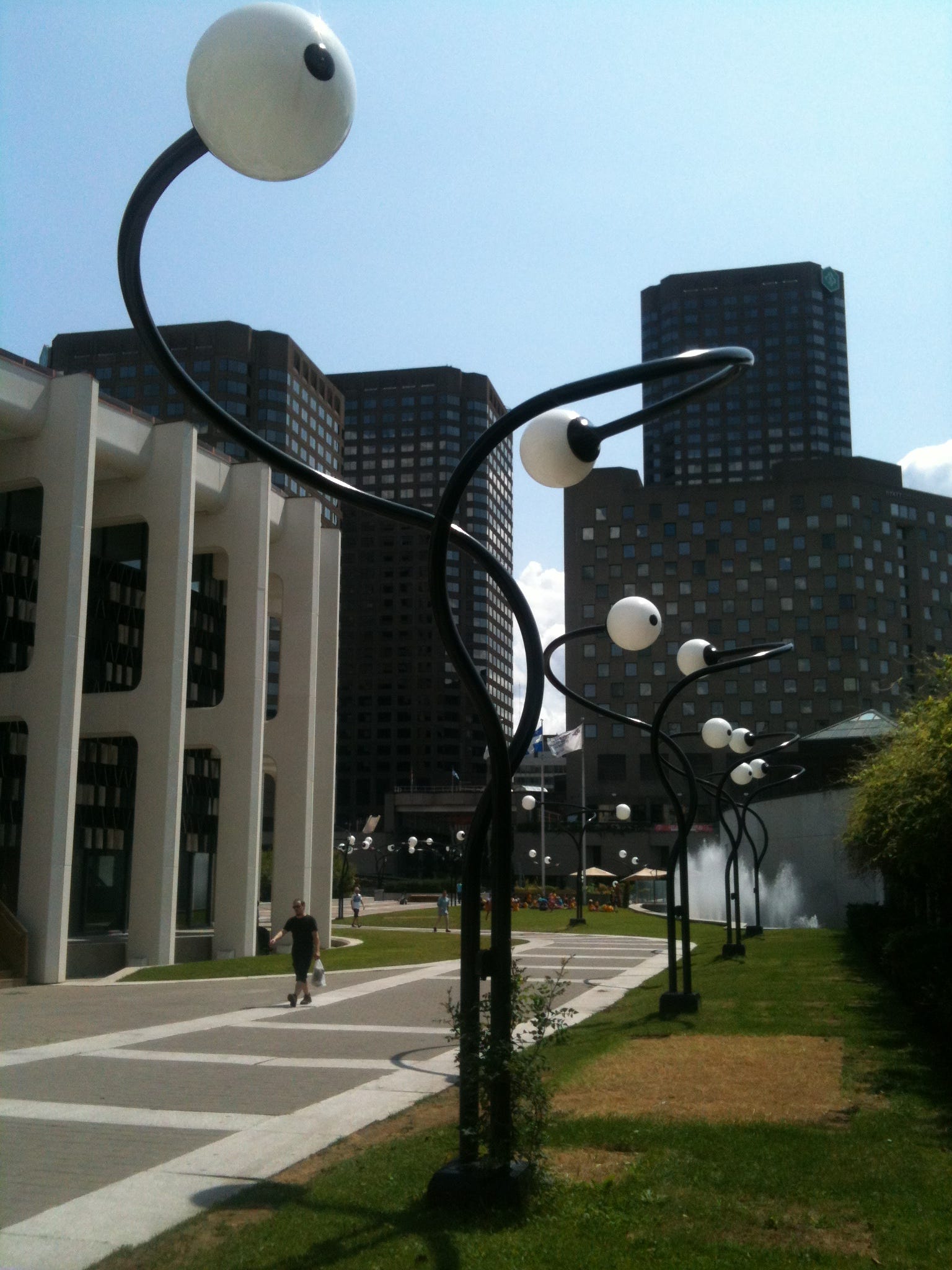
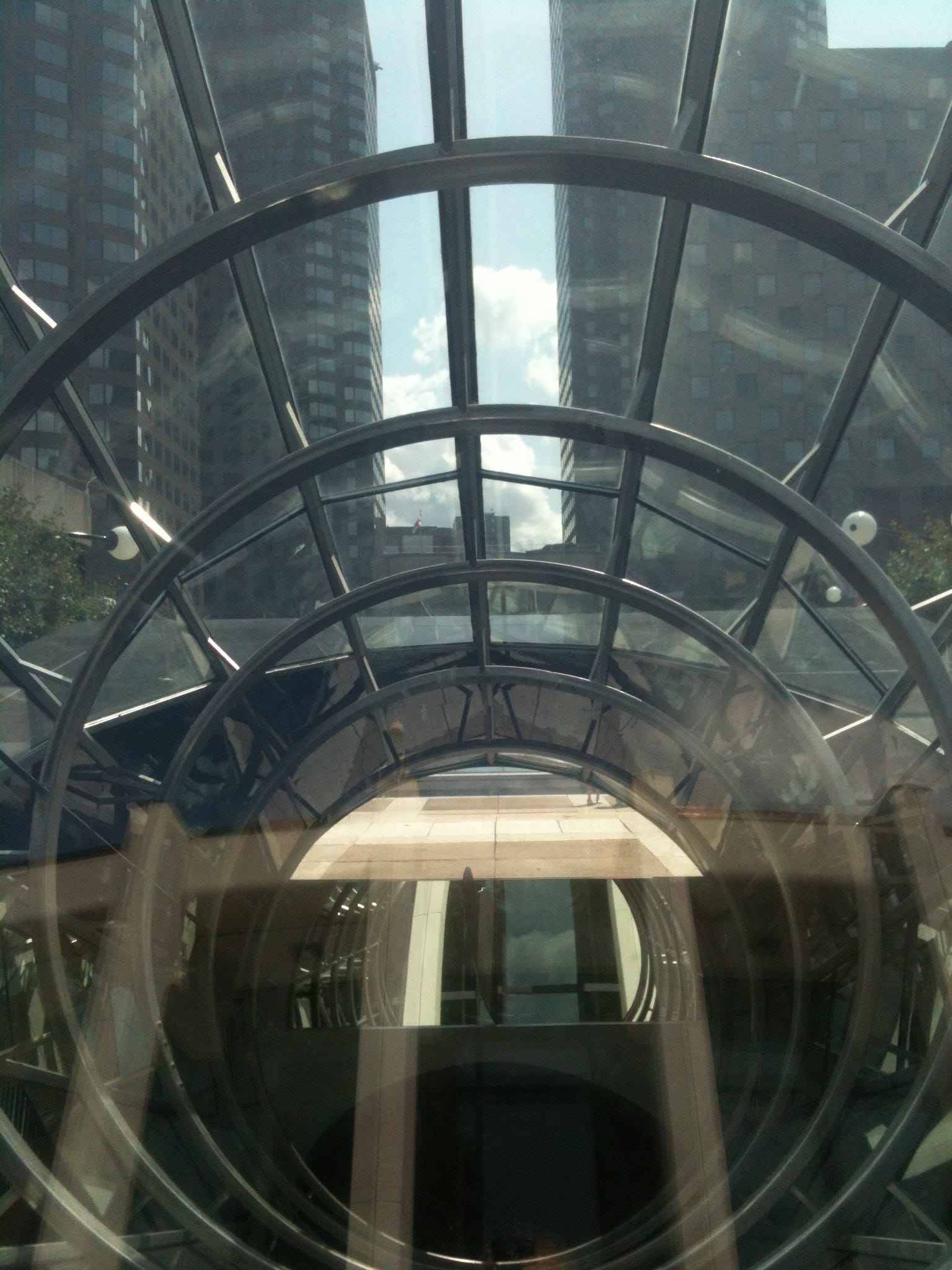
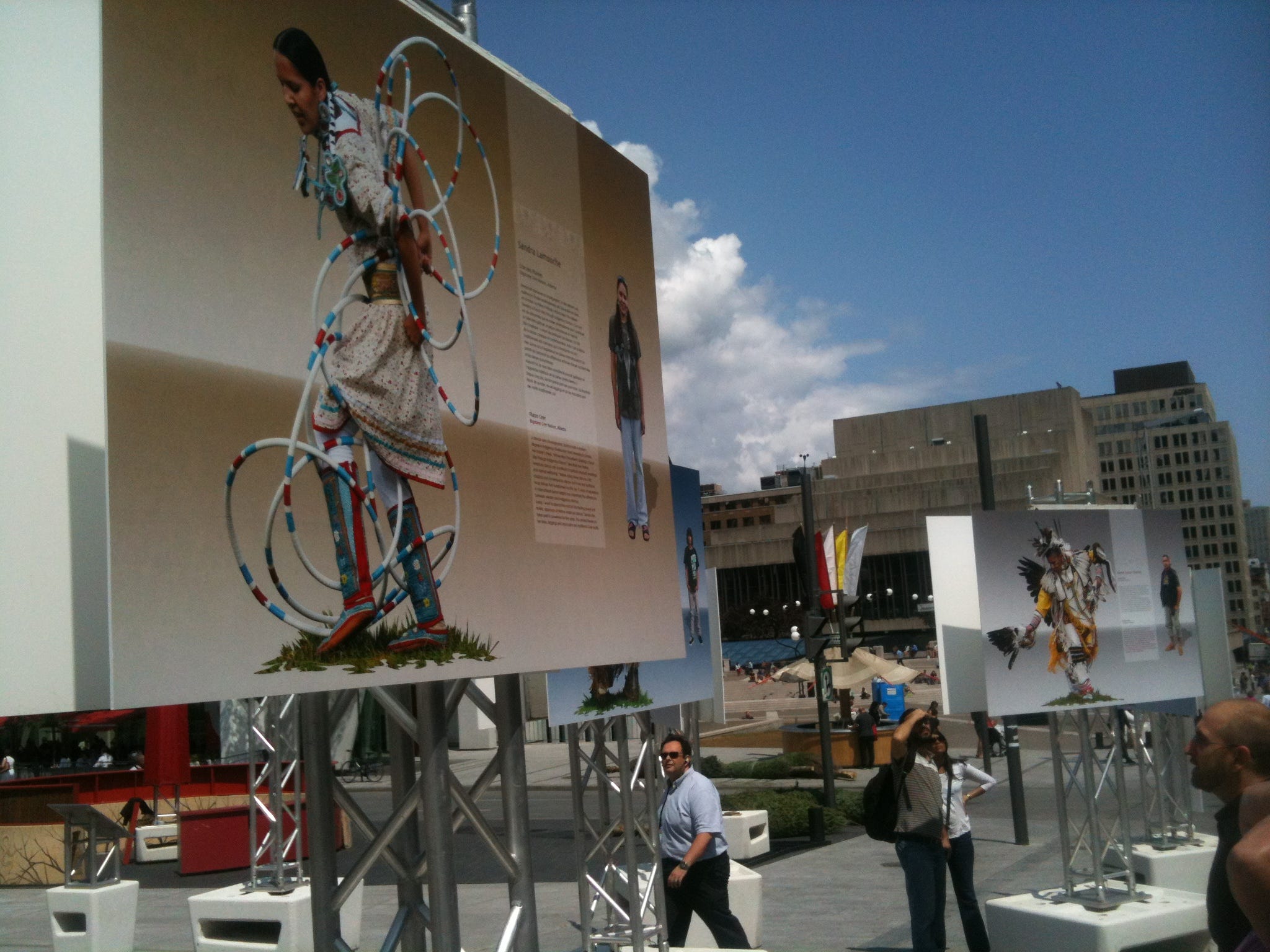
To pick up on a theme I initiated in my description of its Austin equivalent, I find that art museums these days are places for interrogating the act of the artistic view as much as for viewing art per se—and I mean that in terms as much of the physical and mental capacity to take in information as subtext and cultural deconstruction (though the latter is precisely what the artists and curators intend). It is flat-out difficult and depleting to look at artifacts for too long without becoming overwhelmed by the effort, both conscious and unconscious, to organize fresh information. After all, each piece projects its own history, biography, and cultural frame, yet one goes from piece to piece as if they belonged together or could be assimilated in each other’s contexts consecutively. The foiled attempt to do so leads to an oddly disjunctive splay and welter of meanings, most of them subliminal.
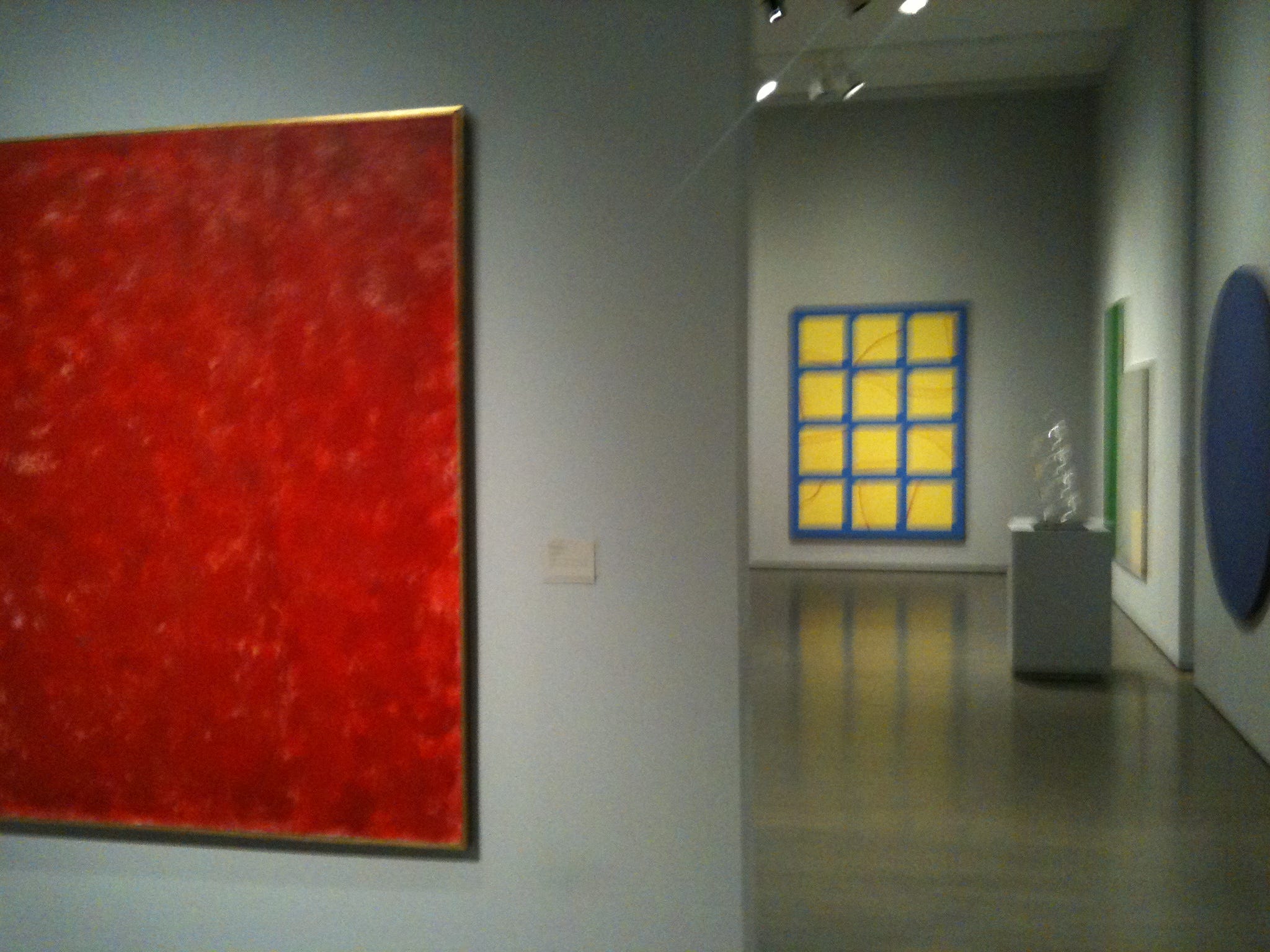
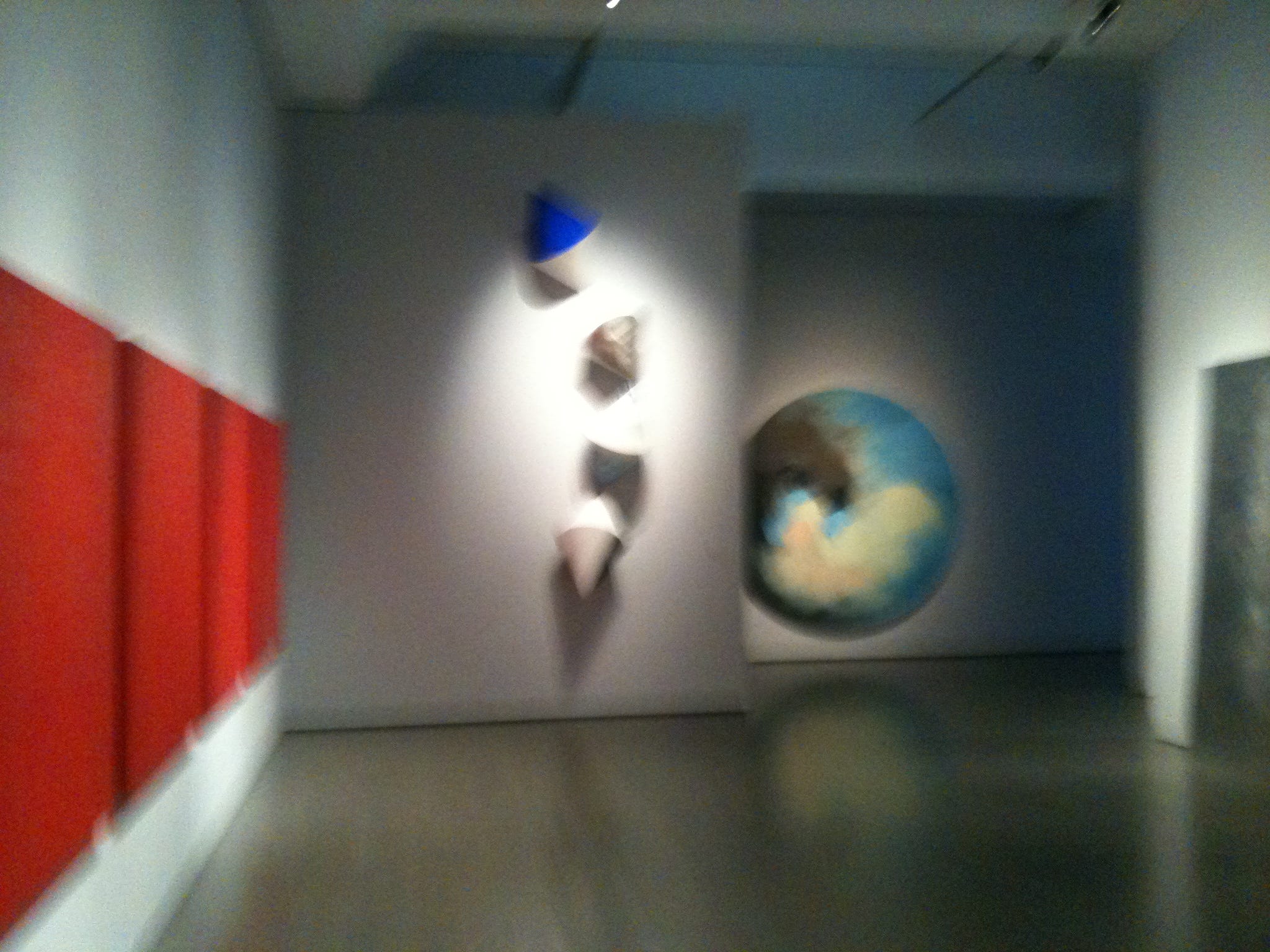
In the case of the Musée d’art contemporain, this condition was dealt with explicitly right away, for the first exhibition up the stairs (to which we were pointed after paying) was a horizontal series of serigraphs or serigraph-like prints or paintings, about nine of them in bright colors, by a Montreal artist named Michael Merrill. Titled by their hues—Cobalt Blue, Yellow Ochre, Cadmium Red, Gold Yellow, Spring Green, Breughel Red, Electric Blue, Grey, etc.—they were meant to depict as art the process of producing and then hanging art, e.g. themselves, in a museum. As such, they were the perfect entry item because their didacticism and banality of topic were alchemized into something compelling by the brilliance of their colors and sleek shadow-like imagery. The overall title of the series was “I Never Saw Documents.”
After that, we looked at a video installation by Canadian-Armenian film-maker Atom Egoyan, an oral history of a woman discussing her childhood initiation by her mother into the magic of a musical legacy by way of old, reel-to-reel audiotape. On one screen the woman is holding and slightly unraveling a tape while fingering it and explaining how the whole thing seemed enchanting and mysterious to a child, and also dangerous because of the fragility of the ribbon and warnings of her mother not to harm it, all to a young girl apparently destined to become a significant musician of some sort (we didn’t stay for the whole sequence to find out). On the other screen an older woman, identified only by her hands (but probably meant to represent the girl’s mother) is carefully operating a reel-to-reel recorder.
From there we watched videos of displaced folk musicians in their adopted countries, riding trains and performing in streets. These were alternately projected on four screens, each visual narrative on both sides of each screen.
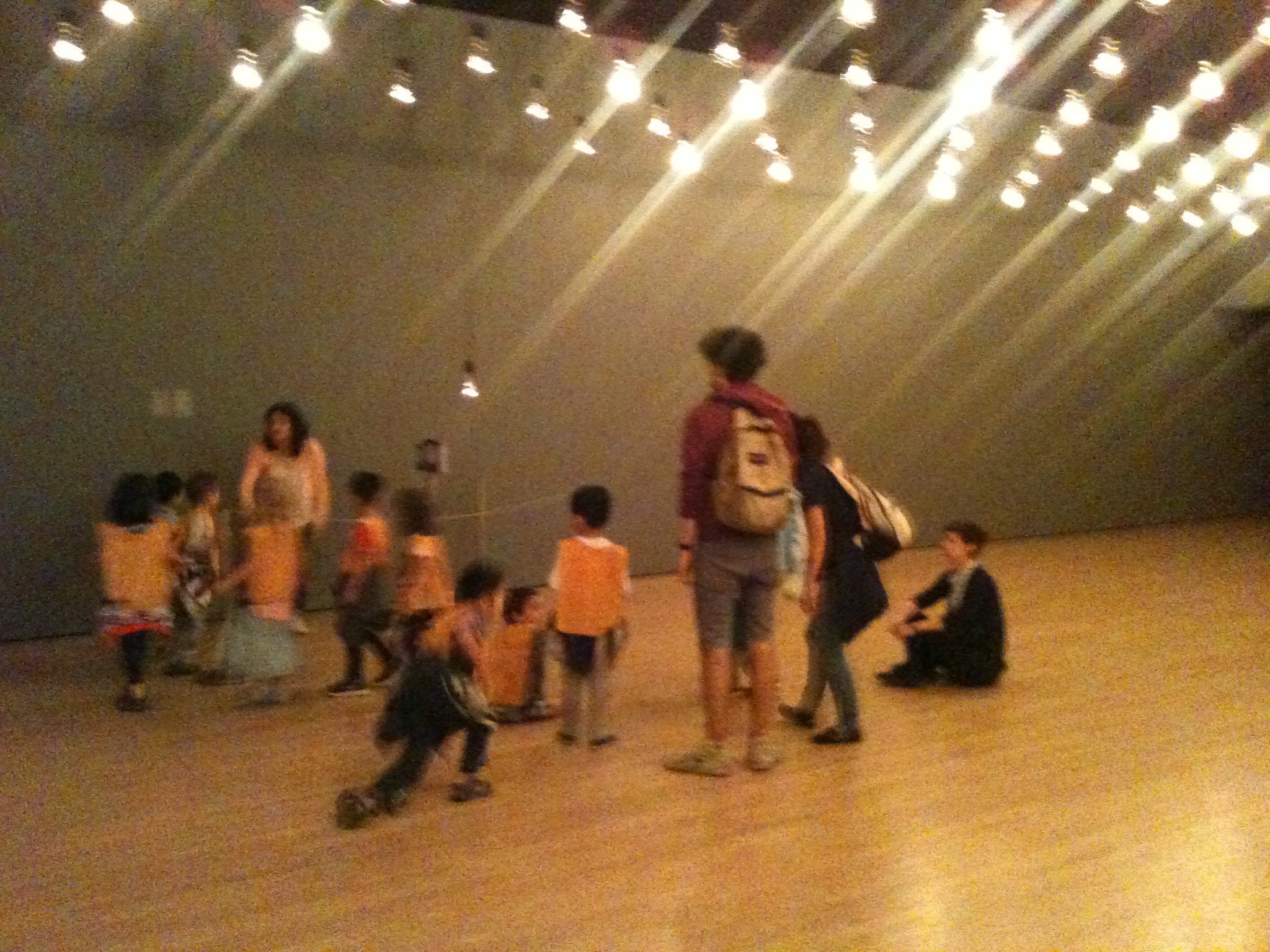
Then we went into a large, darkened room with more than a hundred large bright round light bulbs in its ceiling. I say “darkened,” but the room got quite bright when the bulbs started flashing. A line of children in camp colors had accumulated in the corner of the room and were taking turns activating the mechanism. Each participant held two metal bars for about fifteen seconds, letting go once the device picked up his or her cardiac rhythm, identifiable as a change in the blinking cadence. A few seconds later the entire room went dark and then the light display began dancing on and off in the person’s heart rhythm.
We watched for quite a while, for the kids were delightful in their blends of intimidation, slapstick, and awe at propelling such a personal enormity into motion. We came back to the room at the end of our time in the museum to see if there was less of a line, and there was, so I will attest to the fact that seeing your own heartbeat fill a huge room in the form of waves of rhythmic pulses of light bulbs is profound; it grounds you anew in your own body.
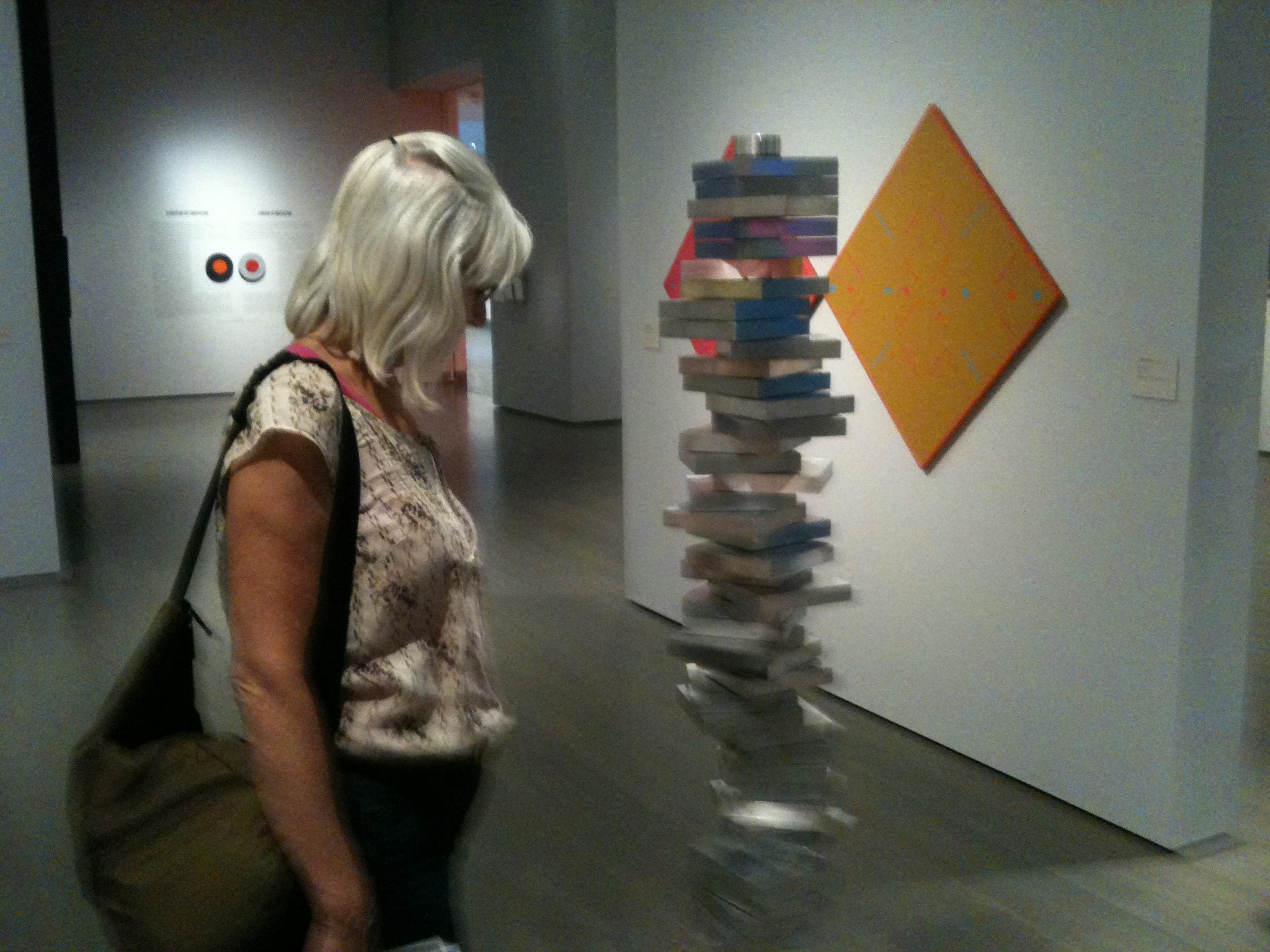
We proceeded into the general exhibits, which consisted of several adjoining rooms of very diverse works in spacious settings. By “diverse,” I mean in every sense: decade of creation, style, color, texture, degree of representationality, degree to which the work leaves the canvass and extends onto the wall, shape of the frame itself (from minimally irregular to rolling jigsaws), overall cosmic dimensionality, etc. The works were aesthetically oriented in relation to each other, sometimes bunched, sometimes isolated; in fact, this building had the best museum feng shui I have ever encountered; I found it possible to be among separate art works in a state of relative relaxation for a long time.
I can’t begin to recount the variant color combinations and designs, but the whole landscape was pleasing that. Not seeing any sign beyond “Do not touch the art,” I asked a guard if photographing was allowed. He nodded, so I did a second pass and took a series of images of not so much the paintings and sculptures as the collective context of the people viewing, about thirty in all. Then, upon exiting the museum, I saw a picture of a camera with a line drawn through it. I can’t explain the discrepancy nor do I have to, but I did feel a bit like a thief slipping off with booty.
We returned to our neighborhood station as seasoned Metro riders (it turned out to be Sherbrooke), switching from the Green back to the Orange at Berri-UQAM.
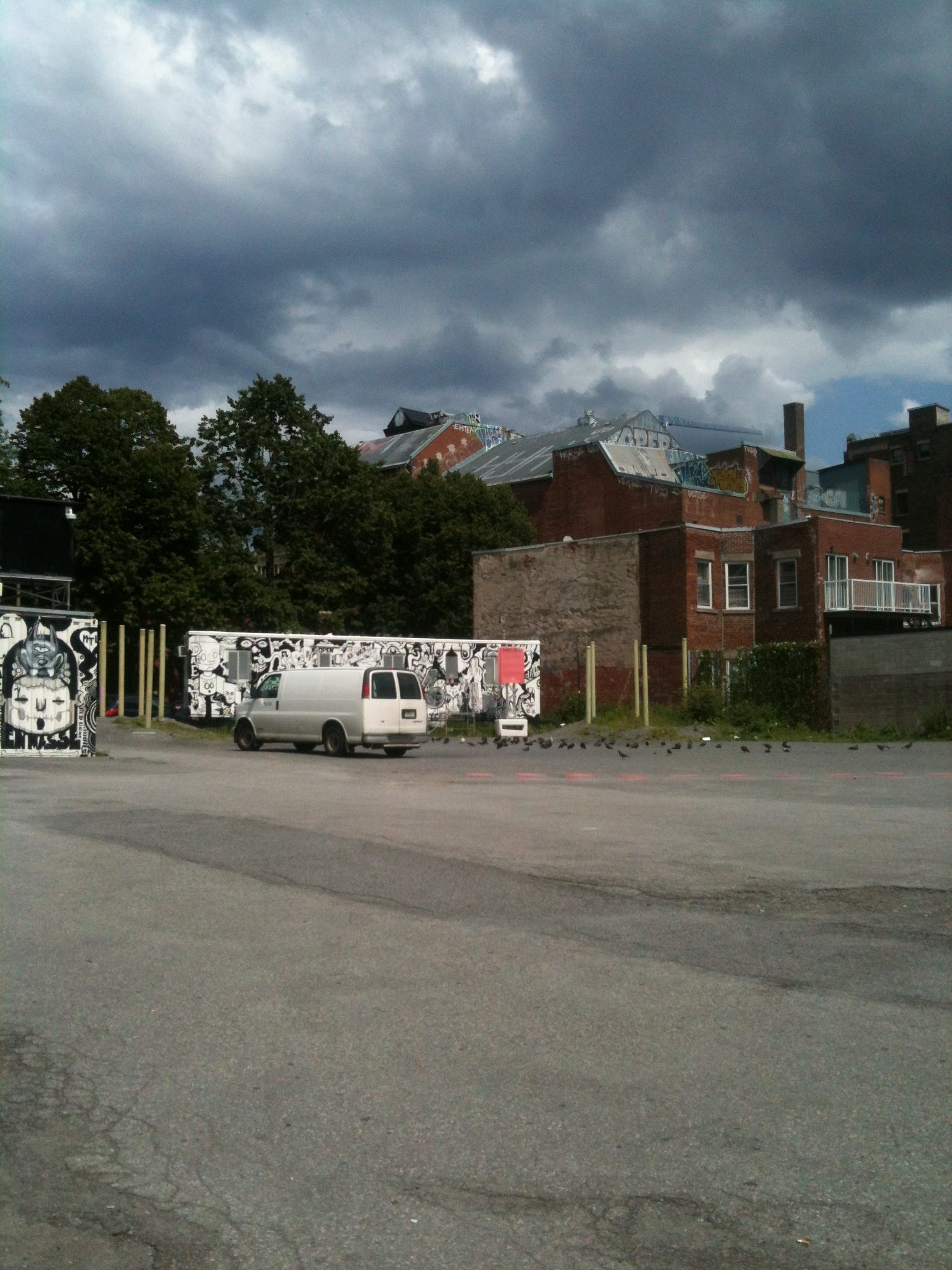
Shot at 6:46 that evening, but I don’t remember what it is, perhaps something bright back from the Museum.
That evening we elected to get more use out of our one-day passes, so we took the Metro to Vieux Montreal on a lark. The actual gambit at street level was totally disappointing—heavily touristed with expensive restaurants, barkers quite successfully summoning folks into them by some magnetism I don’t understand, overcoming high prices and bad food. The architecture and port themselves had rich overtones and antique resonance, but they were a dead stage on which was set in motion simply hordes of misplaced, overamped people.
The best part of the outing was a family of four large friendly folks—Ma, Pa, boy, girl, Lebanese or Syrian—who helped Lindy and me find Old Town, in fact led us all the way there. We met them while wandering half a block from the Metro exit with no idea where to go. We hung with them for a good fifteen minutes, as they guided us back down the exit, through the subway, along a tunnel, and out the other side, all the time engaging with Lindy in a situation established by the fact that the woman spoke decent English but none of her kin did, though her husband had a lot to say to her in French, some of it with evident aggravation, none of which she conveyed to us. He probably wanted her to disengage
Yet, for whatever reason, without any spoken commitment or explicit indication, they did not abandon us and were even loosely protective, though intensely involved in their own debate about it. That is, they shepherded us at a slight distance like a Jovian moon. I am guessing that they were looking for Old Montreal too and had figured out at the same time as we did that they had made a mistake in leaving the Metro, though they never admitted that. For all we knew, they had changed their entire evening plans on the spot to lead us where we seemed to want to go, and then, as an afterthought, decided to eat dinner in Vieux Montreal too. Where we turned, they turned, and then vice versa, Lindy and she all the time chattering away at different levels of English, not only on finding the right streets but through Lindy’s narrative of how we ended up in their company that night (clear back to our departure from Berkeley in in June), a tale which seemed to fascinate our benefactress. Lindy even engaged in conversation with her about whether she herself would like to come to California someday; she would, her slight non sequitur, more a free association, involving a relative in LA whom she’d like to visit, a familiar trope
All the while the woman continued to haggle heatedly and at length with her husband in rapid-fire French (it is 11+ years since this encounter, and I realize that I have dreamed variations of it so many times that I have come to think that the original was a dream too).
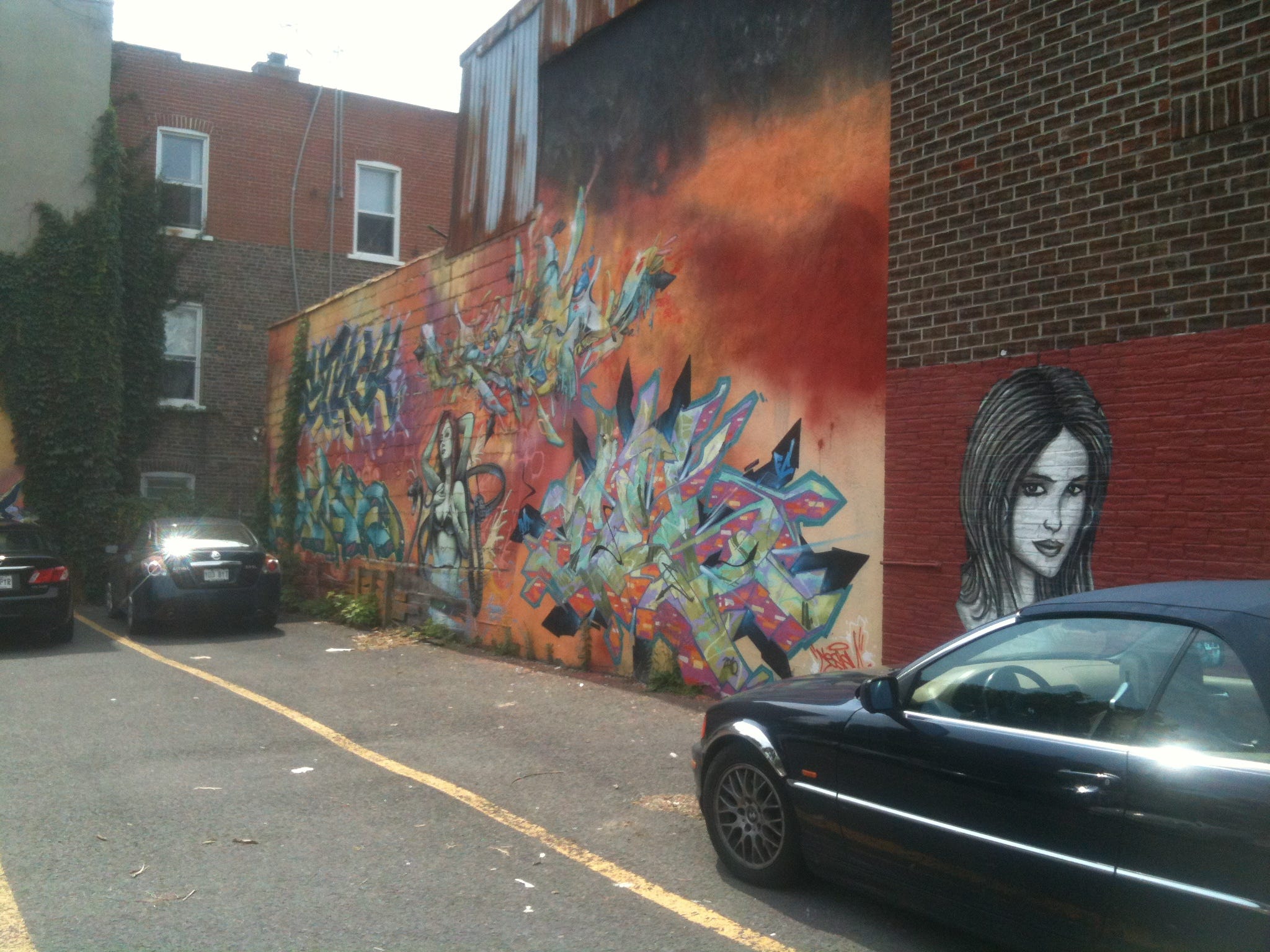
Vieux Montrėal Graffiti—I have used this as my screensaver for the last 9 years.
We spent maybe forty-five minutes in Old Montreal all told after nixing plans to eat there and then. With some embarrassment, we watched a street busker who had accumulated a large crowd. That’s in fact where we lost our friends who continued walking down the cobblestone toward the port. A small fellow with a guitar and an unshaven swarthy Quebecois look (no racism intended, I like the style as well as its indigenous music and dance), was doing anything but indigenous music or dance. He was playing and singing “The Lion Sleeps Tonight” through a portable amplifier in imitation of The Tokens’ old hit while conducting volunteer tourists in successive rows of about ten self-conscious, often-cracking-up dancers doing various booty-shakings and shimmies. Alternately he was leading the rest of the crowd in a kind of collective karaoke version of the song as if the director of a hastily assembled glee club. About 150 people surrounded him, so you could barely glimpse the action. I have no idea what the interest or fuss was about, but people seemed to love him and were having a great old time. He was creating community, but if that was community, I wanted to be back on St. Denis looking for a restaurant. (I have dreamed variations of this too and thought the original a dream too until now).
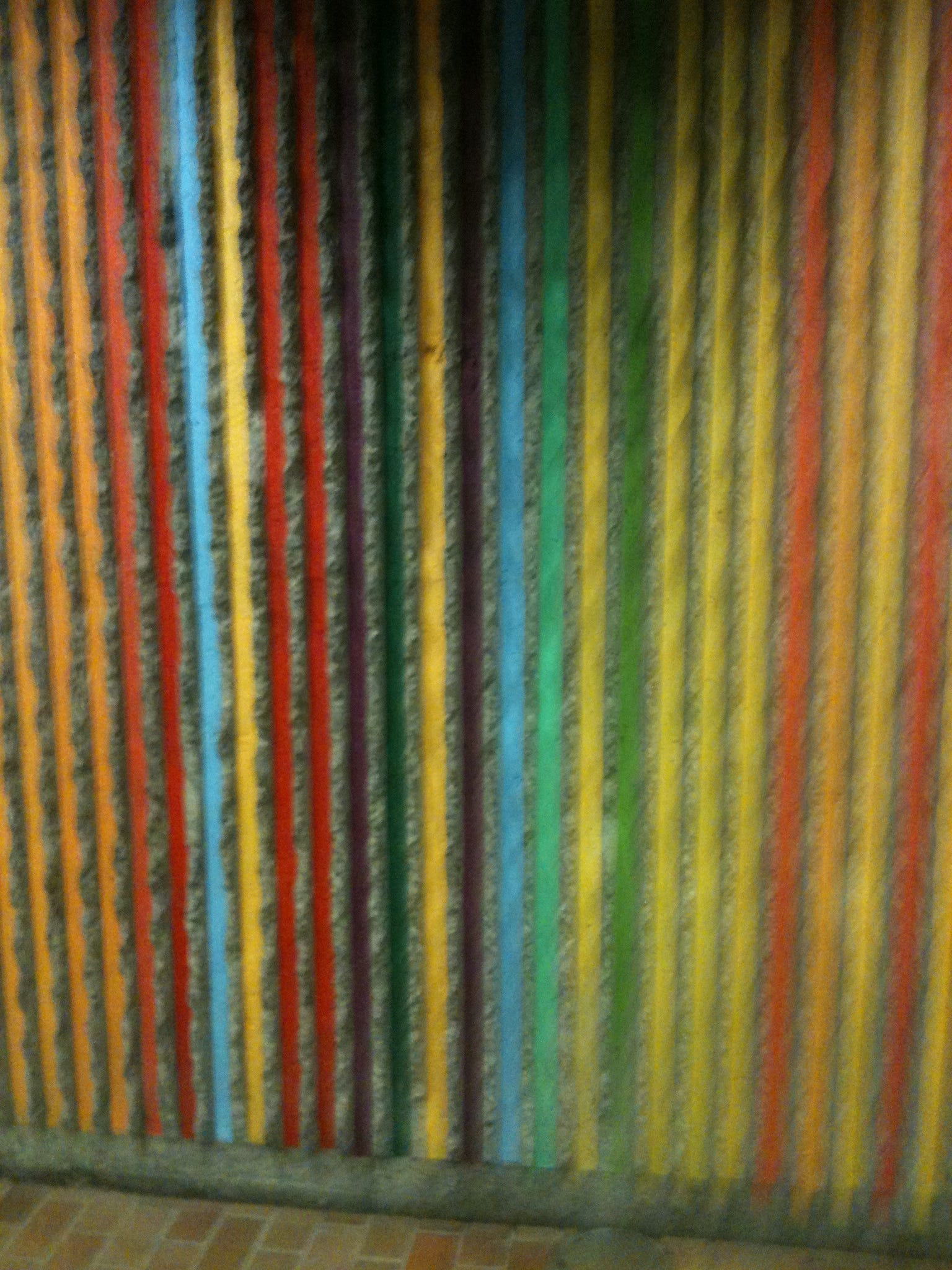
An obscure highlight of the visit to Vieux Montreal was the corrugated wall of the Metro, painted in rainbow stripes that could have been hung in Musée d’art contemporain except that they went on for much longer than the museum could have accommodated; this art piece would have exceeded not only its frame but the outer walls of the building and extended onto the busy streets across vehicular traffic. It was that extensive a paint job. While we were admiring it, we were accosted by the unpleasant fellow from Nova Scotia. Like the family, he stuck to us for a while but without their benign intent.
After exiting at Sherbrooke, Lindy and I went back to St. Denis Avenue to look anew for a place to eat. We chose the Coréen place next door to the Tibetan restaurant. It was called Cinq Mille Ans, meaning 5000 years (of traditional Korean cuisine and culture, that is). Clearly a family venture, the place was both packed and understaffed that night. It took a very long time for the food to appear and, when we started to eat, our suspicions of what was being put before us were confirmed: we clearly had the wrong dishes; yet we decided to eat them anyway. For me that meant non-range-fed beef among the noodles. I rationalized that Canada was probably not as bad as the US in the matter of industrial farms, hormone- and antibiotic-packed meat, and assembly-line ritual slaughters. Whether or not this was convenient denial, t made for social sense and good etiquette to go with the situation as it played out.
We never got our teas either, so afterwards we tried to make sure we weren’t billed for them or the wrong dishes. We worked all this out with a man in his early twenties, part of the Korean family in charge but possessing more English than the others. He was clearly embarrassed for the state of things and insisted we return and let him make it up. I explained that we were driving from California to Maine and so we wouldn’t be back. He ignored that fact as incidental and asked when we were leaving town. Upon hearing that it was Saturday, he pointed out that there was plenty of time. In truth, there was only Friday, as we were going to Jia-lin’s dinner on Thursday. He was undeterred. “Friday it is,” he insisted. “I will make you a special meal.” Then he asked us to wait while he went to the kitchen; he returned with two green-tea ice-cream cones. We thanked him and left, though without a further commitment.
On Thursday morning we made plans to meet Wayne at his apartment at 12:30. In the course of our conversation, he gave me directions to a natural-foods market near his place (and not far from ours) at the corner of Rachel and Berri. Since we hadn’t been able to find one thus far, I walked to it right away, shopped for what we needed, and came back with a heavy bag and a sense of accomplishment.
Hilarious sight on my return: a female likely-professional dog-walker was leading five different sizes and shapes of pups on leashes including two large white Scottish terriers with a lot of hair in their eyes. A squirrel darted across their path. In unison they turned their heads and pulled like a team of huskies such the woman could barely hold all five even as she dug her heels into the ground and crouched low. After she got them under control and led them away, they continued, though not in unison, to look back over their hinds for a glimpse of the Sciurus carolinensis provocateur.
We used our subway cards one more time at their last hour to go a single stop to Mount Royal and then we walked that avenue to the park. It was a more varied, less upscale commercial neighborhood than our sector of St. Denis, with diverse markets, furniture stores, and variety shops. The feeling was college-like, suggesting a rehabilitated Telegraph Avenue in Berkeley or State Street in Ann Arbor.
We made it through the district to Mount Royal Park, a vast expanse rising uphill to a Cross set at its top, designating (in my mind anyway) Leonard Cohen’s city of saints. There we sat under a giant oak at the end of the initial expanse of fields, watching tennis players and gulls and taking stock of our lives and the enormity of what we were doing. At unexpected moments, the daze wore off and the sense of shock returned.
When we began counting gulls that had landed on the field (fifteen), we knew that it was time to climb some more. So we trekked uphill to the next rung where the density of trees increased, and from there watched the city clatter and breathe. Noon told us to head in the direction of Wayne’s, since we had only an approximate sense of the distance and time from there.
It was not a simple stroll. Well, it started out as a quiet walk but, as we got close to his street, the instructions coming from the opposite direction misled me, and we overshot it by walking from Rachel to Duluth to avoid construction and then had to walk the entire distance back plus some extra to get to Wayne’s place. What added urgency and made me doubly regret my error was that the whole sky suddenly darkened and, with rumblings of thunder, threatened a major downpour. We had left our apartment dressed for a warm, summery day. As it was, we found Wayne’s front door and rang the bell just as the first drops were landing. A deluge followed, beating and flashing lightning on the windows and sounding a diffuse din from the streets while we visited in the living room.
We sat on chairs among four playful kittens, all with designated homes once they were weaned. For now, they did the usual: attacked shoes, chased under furniture, and curled up in a ball at the foot of the scratch post, as we and Wayne recounted histories from our last meeting in 1976.
I would not have recognized him or more accurately not recognized him as Wayne, though I think I would have grokked that I knew this guy from somewhere. Thirty-eight years engrave indelible artistry, cell by cell, even as they crafted an immaculate body in the first place. The metamorphosis from child to young man (and young woman) and then to full-fledged adult and to elder is as gradual as it is profound and, like the shell of a tortoise, tells a thousand tales. Time’s transformations take on a rich flavor when so many decades intervene. Every old friend we had seen recently in Canada—Victor, Merrily, Andrew, Wayne—had re-costumed himself/herself from the cameo starring role of youth to the gist in which they had incarnated, leaving behind most of their affectations, conceits, pretenses, and primping.
Since 1976, Wayne had followed an interestingly fated route: he had moved to southern Vermont and lived in a barn while he tried to achieve the next level as a writer, finally giving the whole thing up as “I’m never going to be good enough to reach the top tier and nothing less is worth my interest or time, it’s Yeats or bust.” He printed t-shirts for a bit of income and ended up several decades later with a full Vermont-and-Florida t-shirt business employing ten people in Burlington to which he commutes maybe once a week while residing in Montreal. In the process he joined SABR (Society for American Baseball Research) and not long ago had taken a dedicated baseball journey to Cuba for which he wore a souvenir t-shirt, a typical Cubs jersey with the exception of an “a” in place of the “s.” It was not one of his company’s.
During the same period, he had married twice and had two children and a stepchild, all successful at one thing or another on the West Coast. In fact, his daughter who had gone to Haiti recently in the service of Oxfam was working on her PhD at UCDavis and, with her husband, had just bought a house on Francisco Street in Berkeley. They had had to overbid by more than twenty percent after missing out on a previous few. We had no such “luck” as a seller. Our original buyer withdrew his offer and we accepted the back-up and then absorbed some of the deferred maintenance to boot—our greater vicinity to the Hayward fault, plus that Kensington isn’t quite Berkeley or San Francisco.
Wayne explained how his grandmother ran Brown’s on a kind of scam, extending to the executives from Sullivan County National Bank tons of free meals, gratis rooms for their friends, and other perks, while continuing to get loans from without fulfilling the obligations. Once Citibank, or whoever, bought the local institution, its principals put a quick end to the practice and Brown’s quick folded; then it burned to the ground under different ownership.
The rain did not abate, so our lunch choice was limited to a Portuguese place on the corner, Wayne in a slicker, Lindy and me sharing an umbrella as we hastened. Lindy and he ate there. I didn’t—it was meat-oriented, cooked on spits right behind the counter, and I wasn’t feeling very good anyway. We sat at a table and exchanged more stories. The most memorable one (to me) was Wayne’s tale of the breakdown of his last marriage while on a home exchange in Paris: “If we hadn’t had our son and his friend with us, we might have killed each other.”
When Lindy asked if he was looking for another relationship, he feigned horror. He said he had never been happier than now. He liked his solitude, his non-interest in romance, and was very much into biking. In fact, in a few days he was leading a Quebec group of which he was the head on a five-day pedaling- and-camping trip along the north side of the St. Lawrence River.
The rain still hadn’t let up, so we “borrowed” Wayne’s umbrella to traipse back to our temporary Montreal home; that is, he could get another one.
The arrangement that night was for Jesse and Angus to come by our place and then for Jia-lin’s daughter Kelly to drive there a bit later, collect everyone, and bring us to Beaconsfield, a good hour away in rush-hour traffic.
A bit about Kelly: she was raised by Jia-lin’s parents not her mother who, in Mary’s account, did not want to be saddled with children. In fact, Kelly had had no contact at all with her birth mother for more than ten years and did not know where she was presently located but thought that it was maybe Bolivia, more likely that than China. Kelly had come to Quebec at age twelve and considered Mary her de facto mother. She had lived in Canada since then except for a marriage to a Japanese student in Montreal with whom she spontaneously moved to Japan. They were there for seven years until one night when he didn’t come home. After his departure was clearly ratified, she moved back to Canada. Since then, she had lived variously in Ottawa and downtown Montreal and was now ensconced at her parents’ house while she studied 3-D animation for a career change. Mary told us that Kelly was quite willing to run this errand, adding that she was very upbeat and good-humored like her father.
qWhile writing this entry, I asked Mary for a summary of Kelly’s career so I didn’t slight her, and she wrote:
“She is an accredited travel agent and worked in that field in Ottawa and Montreal. She also has a diploma from a private college as a make-up artist, but she didn’t get a chance to work in that field because her husband decided they should move to Japan. In Japan for seven years she worked as a nursery-school teacher, eventually becoming head teacher. Then when she came back to Canada she took an eighteen-month course of studies at Computer Data Institute in 3-D modeling, animation, and design.”
I am glad Kelly didn’t mention till late on our drive back that she also loved motorcycles and raced cars. The jaunt out to Beaconsfield was like a NYC taxi ride, though I’m not sure I trusted a girl from the People’s Republic quite as much as a New York cabbie but then, after all, what is a NY cabbie anyway but a guy from one or another people’s republic or Eurasian theocracy? Kelly went hair-raisingly fast, getting right up behind cars at full-commitment speeds. She explained that the rule of Quebec driving was Bostonian: “Seize space. If you don’t get it, someone else will.”
She had an interesting way of changing lanes that I was not familiar with. It was as though she put the car energetically in the next lane first with her aura and then the metal yawed to meet it. That is, her moves were mind, then matter: it vaguely felt like riding in a large suspender. She didn’t use her blinker because that was like giving her opponents an undue advantage. As to going too fast for anything but a crash if the car in front were in an accident or slammed on its brakes, she said, somewhat non sequitur, “Drivers in Ontario are worse. No, Quebec drivers are just as bad, but Ontario drivers are stupid too. They don’t have a plan. I always have a plan.” I was curious to know what the plan was, but I’m glad I didn’t have to find out. Her final answer was, more or less, “I got a motorcyclist’s license in Japan and, if you knew how hard that is to get, you’d realize that you can trust me.”
That’s good because we had no choice.
At the door in Beaconsfield, everyone stopped to admire Jia-lin’s garden, clearly the pride of the neighborhood, an extensive collection of flowers and herbs with a few large trees that, he informed us as he came out the door to enjoy everyone admiring his handiwork and curtly shout out names for anything anyone dawdled over, he had planted from scratch. Mary added:
“In bloom in the garden right now are different kinds of day lilies. But it depends on which month/week one visits, as it is a passing parade of hundreds of different blooms and blossoms. Almost all are perennials, except for some pansies etc. on the front stairs. So things follow their own rhythm and appear on cue in a succession of flowers starting in April or May and extending till late into autumn.
Joggers and cyclists like to make this part of their route to see the garden; one lady said she felt the garden was just inviting her to come and play in it. A local seniors residence always makes a point of driving their little shuttle bus by the house, even though we are on a crescent that is not en route to anywhere.”
Inside, after drinks and conversation (and once Russell and two neighbor kids, who actually looked like one boy made in triplicate, had finished their meal and gone off to play Minecraft), Jia-lin produced his banquet spread across a large table. It consisted of soup in a carved-out watermelon, a duck dish, a trout dish, and various other items making up an entire buffet. Mary told the group:
“Jia-Lin’s dishes don’t have names. I think duck figures in a few of them, including that soup invention which has a duck-broth base and has shrimp in it and which was baked in a watermelon in the oven. It has tofu and veggies in it too. There is also a dish with duck and some kind of sauce. There is a vegetable dish with mushrooms and assorted Chinese vegetables and chayote, and a shrimp dish with lychee fruit. Oh, and trout with peaches.”
Dinner discussion ranged over topics from Kelly’s international adventures, what the three boys were doing upstairs (Kelly came downstairs mock-weeping that she had just been dissed and kicked out by a trio of nine-year-olds playing Minecraft), the over-amped house dog, Jia-lin’s time in China, Angus’s plans, Asian martial arts, the preparation details of the dishes, what the people’s actual names (Jesse, Angus, Kelly, etc.) were in Chinese. It turned out that their Canadian names were merely the closest agreeable Anglicizations the parents could form of the person’s Chinese name, something I would not have guessed. I thought of them as attempts not to be Chinese.
Still remarkably patient and respectful, Angus only got peeved at his father once and that was when Jesse said one time too many, with exasperation (this time in relation to Kelly’s time in Japan), that Angus wanted to go there, maybe to teach English as a second language, at which he then shrugged, perhaps, without intending it, a bit contemptuously.
“You keep saying that,” Angus snapped, “and it’s not true. I never wanted to teach English as a second language. That’s your fantasy. I wanted to go to study judo katame waza, period. No other reason. I never just wanted to go there.”
Smiling almost beatifically, Jesse stayed undeterred.
After dinner the whole dinner group minus Kelly, Mary, and the triple- Minecraft boys went on a walk through the neighborhood, to the St. Lawrence and back, the river quite wide and magnificent at this point. We strolled past stately houses, some with turrets, all part of peripheral Anglophone Montreal (no council vote for an extension of the Metro here anytime soon either). The jaunt took a good forty minutes with Jia-lin leading the way. I lagged behind with Angus, and we discussed various edgy topics like chemtrails (for, if there were such things, there were plenty of them presently overhead), UFOs, modernity subtexts, personal consciousness (a topic Angus brought up), and Dreamworks, with the curious twist that my half-brothers in the Grossinger family, Michael and James, played with Dreamworks director Jeffrey Katzenberg as children. His father Walter and mother, name long forgotten, were friends of my father and stepmother, and I was occasionally present and got included in their games. It was a bit of trivia for Angus to take to Shanghai for the right moment to spring.
Kelly’s drive back into Montreal Centrale was even more aggressive. I sat in the front seat (both times in fact because of susceptibility to motion sickness). Lindy, in back with the Ning family, just closed her eyes and hoped for the best. Kelly insisted many times that we were perfectly safe. It was not a quick re-entry. There was a plenty of evening traffic and heavy gridlock once we got into town.
I found ice hockey a compatible topic with Kelly but reduced her to adolescent razzing by mentioning that I rooted for the Ottawa Senators. She let me know how meagerly she thought of them. Then she shouted, “Go, Habs” repeatedly and, over the next fifteen minutes, went on about her team and their issues (they traded or lost too many good players, had too many rookies, etc.). A number of times she apologized in advance “for my language” but never used a stronger word than “ass.” She said that the Canadians kicked this team’s ass and that team’s ass, most notably the Bruins, and then she added that the mayor of Boston had been forced to fly the Canadian flag in shame, a thread I lost somewhere along our bumpy, swerving way, probably during a distracting lane change.
As Kelly sought the best route through gridlock, we encountered many downtown neighborhoods at night, including Chinatown and the red light district, all glided through as if a movie from a car.
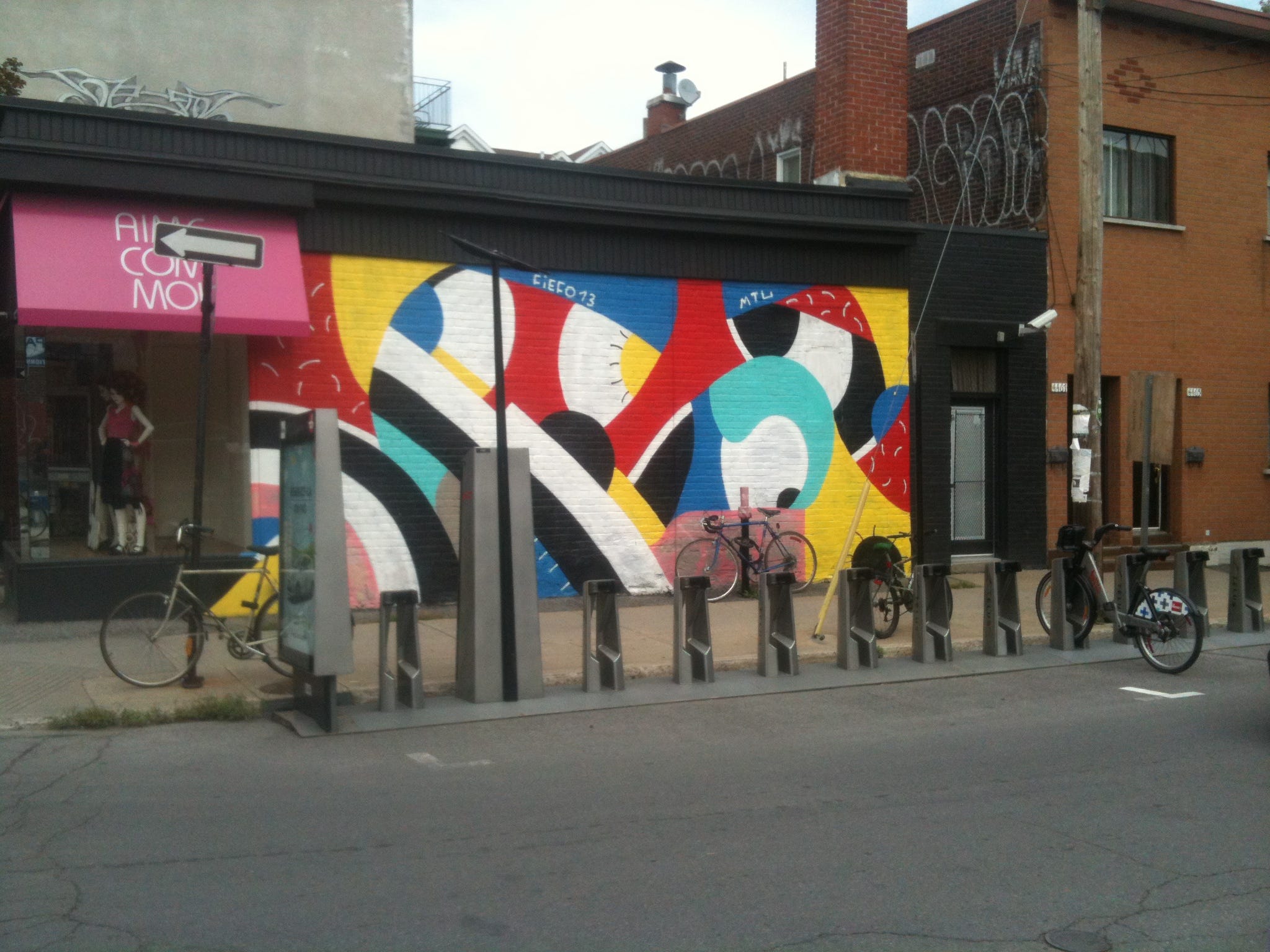
Our schedule was set the next day by Vendredi street-sweeping. We unparked our Prius, drove to Mount-Royal, ate lunch outdoors at a vegan café, and walked to the park. On the way back we stopped at Rachel-Berry, the natural-foods market, to buy lunch makings for the trip to Maine the next day. When we returned to the apartment, lucky to grab the last parking space for nonresidents again, we discovered that an expensive bottle of chlorophyll tablets had been put in our bag—and on our credit card. Under the circumstances I decided to walk it back but, when I arrived, all those people who spoke perfect English just a half hour ago as well as on the previous day suddenly seemed not to understand me at all. They shook their heads, communicated a policy of “no returns,” and went about their business as if assuming I’d give up and leave. But I kept insisting that it wasn’t a return, I never bought it in the first place—perhaps a previous customer had left it on the counter by mistake and the checker had missed it. Finally a clerk came to the back of the store where I was talking to a possible manager and she handed me a stack of thirteen dollar coins plus some change. I went around the store looking for other things to buy that matched the amount of my coins. I left with under a dollar in Canadian change.
A couple of hours later I took a stroll by Cinq Mille Ans, the Korean eatery, and met the same young man, on duty at five o’clock, prompt as promised. He introduced himself as MingGi Choi (he wrote it out for me), shook my hand and said in response to my ambivalence and said “You must come tonight. Where is your wife? I have prepared a Korean barbecue for you two.”
“She’s at the apartment. Are you sure?”
He nodded.
“Then at least let us pay for it.”
“No way. On the house. You choose any table you want. Do you want to be indoors or outdoors?”
“I think outdoors if it’s available, but we can eat indoors if someone’s at the table. I don’t want you to lose a customer.”
“No, it’s your table. What time do you want?”
“Maybe six.”
“Okay, I will be ready at six.”
I handed him the last of the copies of my books I had been toting from Berkeley. The book was all I had left of a personal to give, and it was more in the spirit of the moment than an exact balance of the transaction or that he would be interested in reading it.
When Lindy returned at six, a picnic table that could have seated ten was set for two. A Korean flat wok-like pan steamed at its center, giving off hot piquant fumes as MingGi attended it. Once we arrived, he brought out slices of beef. Again, I conceded to myself that it was Quebecois and not industrial US cow. Then he made Korean stir-fry in a separate dish, also right there at the table, as we conversed. He brought us each beers, though I traded mine for sparkling water. He continued to hang with us as we ate and there were few other customers yet. In answer to my questions, he said that he had come from Inchon eight years ago and liked Quebec much better than Korea—it was more laid back. He was working on an advanced degree in economics at a university in Montreal, the main branch of which was in Paris where he hoped to continue his studies next year.
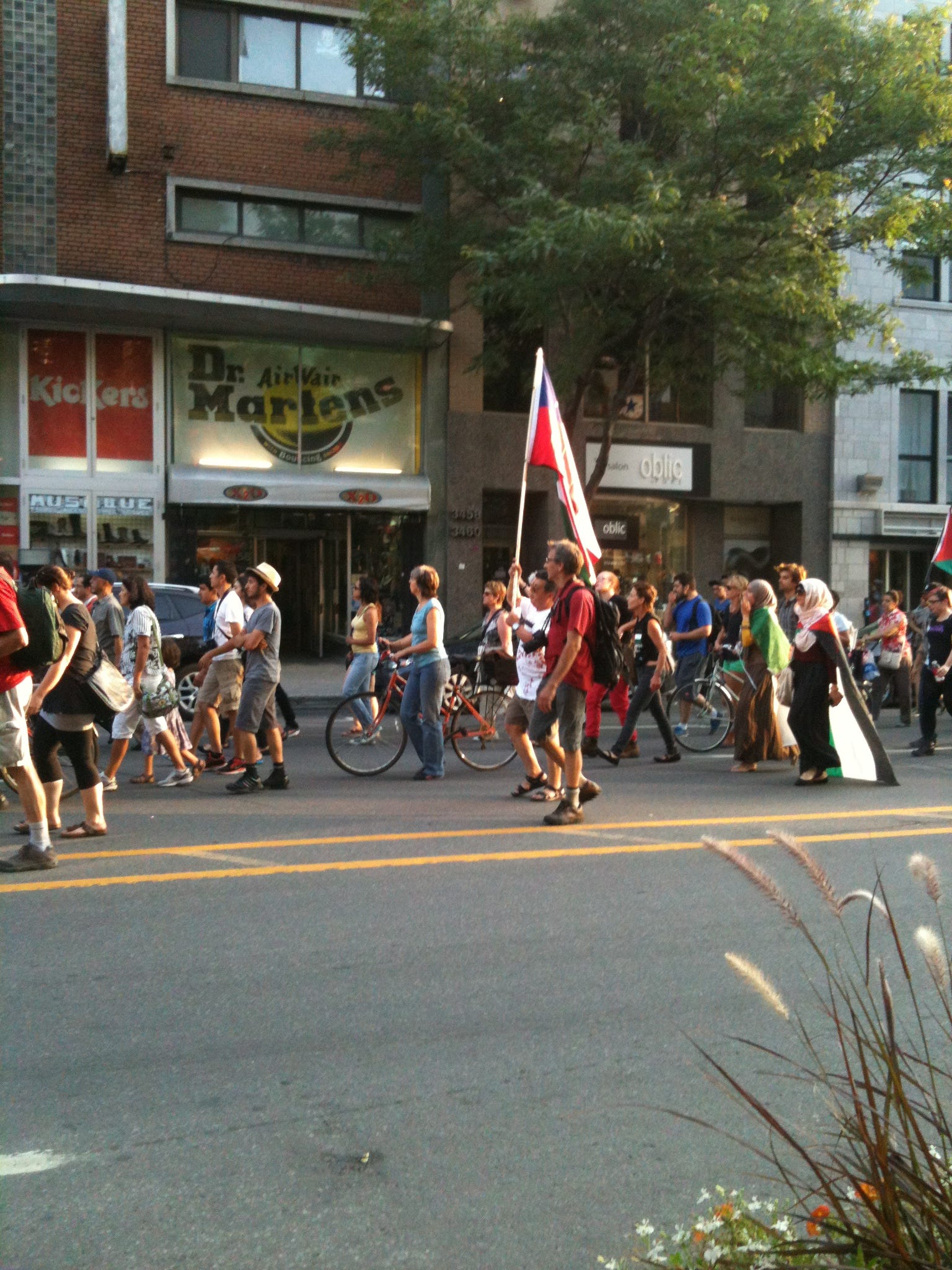
While we were eating, a flurry of police cars came shooting down the street, about eight of them without sirens but with colored flashing lights. We and other diners stood up to look. Initially there was nothing to see, but then a protest march appeared in the distance, headed down St. Denis. Before their signs were visible, I wondered if the cause was Quebecois or international and, even as I hoped it might be a response to the bombing of Gaza, I could see the first sign: “Free Palestine” in French and English. It sent chills down my spine. Other banners heralded self-determination for Gaza, etc. The demonstration brought together Muslim women in chadors with Canadians. They were loud as they shouted in French and English.
I know that it’s romanticism and the type of stuff that gets you called a self-hating Jew, but I found the black, white, and green Palestinian flag with its jutting red-orange triangle at the margin thrilling as it flew on the streets of Montreal—no Zionist counter-protest anywhere, no AIPAC remonstrations. It was clean and moving and struck not so much at the whole Israeli-Palestinian thing as Rodney King’s “Why can’t we all just get along?”
For all the complexity, there is also an Arendtian simplicity to the institutionalized killing of civilians, by whomever, wherever. And you should never take an eye for an eyelash.
I feel an extra responsibility in being Jewish and standing against Israeli right-wing Likud politics. But I’m no naïf. I get it about Hamas and their missiles and tunnels and wanting to obliterate Israel or, more properly, to allow pragmatically for its existence while refusing to acknowledge its right to exist (I feel this far more strongly after the epicly cruel October 7th, 2024 invasion). I understand about the complex politics that has Egypt and Saudi Arabia and even some of the Arab emirates in secret collaboration with Likud against Iranian proxies. I understand that Israeli and US intelligence networks are irrevocably tied together and interdependent at the highest levels, particular in relation to Al Qaeda and post-Qaeda jihadist groups and that all of our safety depends on it—which makes American neutrality virtually impossible. In fact, militarily the US and Israel are the same country. I get too that there are no angels in the Middle East. But I can’t stand the Jewish sense of superiority, persecution, and racism; I have experienced too much of it directly in my life. It replaces the old Jewish tradition of decency, tolerance, and justice. It’s why Nathan Englander was asking, “What are we really talking about when we talk about Anne Frank
I mean, I got kicked out of Hebrew school at age eleven for complaining when we were asked to throw darts at pictures of Nasser and other Arabs at the Purim fair, an incident I have written about in a number of boooks. “They’re not people,” the principle explained, “they’re animals. And you, son, are an anti-Semite.” That was 1955, mind you.
The Settlers are no better than the US Tea Party, or those Dixiecrat slaveholders who wanted to conquer all of Mexico until they found out it was anti-slave, or the Andy Jackson/William Custer faction removing Amerindians— racist, provincial, fundamentalist, macho, self-righteous, sociopathically uncompassionate, narcissistically entitled. Yeah, there are two sides to every story, and I’ve got Facebook friends who post every little pro-Israel, anti-Palestinian squib they can suck out of cyberspace, as if you could ever change the true reality of land theft and disenfranchisement or apartheid or make it right by rhetoric.
Those people, the Palestinians, were there, whether before or after the Jews of the Old Testament, and clearly they didn’t want any Ashkenazi resettlement of Israel in 1948 by folks were not pure descendants of Semites who left in 70 CE but mixes of Hebrew, Israelites, and Northern Khazars—from the Indo-European root qaz-, “to wander,” and who wants uninvited guests anyway, especially guests who take your homes and kick you out, set themselves up as civil authority, judge, and jury over your land, and legislate away all your rights?
I know, many Israelis are more decent to Palestinians than most Palestinians are to Israelis or to each other; they try to mitigate harm to them, educate and heal them, and provide services and revenue that they wouldn’t otherwise have. But when you have the upper hand, so much more is required of you—so much more than what you can afford at the level of self-congratulation.
I side with my childhood friend Phil Wohlstetter who is only half-Jewish. When accused of being a self-hating Jew for supporting the Palestinian cause, he said, “Only half of me is a self-hating Jew; the other half is an anti-Semite.”
After leaving a tip for Jesse with a member of his family, we hurried down St. Denis behind the march to see if there would be speeches or countermarchers, but we never caught up and ran into crowds of diners so thick across Sherbrooke that pedestrians could barely move. It was suddenly women in strapless red dresses and young couples lining up outside cafés. In modernity, a march with Palestinian flags melts into the urban landscape.
On our last night in Montreal, the “other” couple returned prematurely from their Quebec adventures. Nothing wrong with them: two sweet young Parisians, the male very tall and French, the female tiny, Vietnamese, just as French. Both them had a good command of English for basic conservation, they unconsciously occupied a lot of space. Their stuff was in the kitchen, half-drunken Coke and beer bottles and half-eaten candy bars. They initially arrived at the apartment midway through our first evening and socialized briefly while taking possession of space. In the morning the woman stopped me on my way to the bathroom after the guy had already just been locked in there for a half hour, saying, “Please, okay, just one minute.” She held up a single finger. She may not have broken the all-time record for time in the bathroom, though she challenged it, and she did break my all-time record for one minute in the bathroom when someone else is waiting: fifty-seven minutes; she apparently took a complete shower and conducted cosmetic prep. At one point, I considered going out to look for a restaurant loo, but I kept thinking, ‘It can be that much longer.’ It always was, but I did make it to her eventual breach through the door. I even waited an extra two minutes for a graceful succession and to remove any potential drama.
They ran on a youthful lack of empathy. They smoked. They didn’t do it in the apartment itself, but they smoked up a storm outside on the back porch and it drifted back. We had taken to locking the back door at night because of carousing and bottle-smashing spates on the street. The two young Parisians didn’t know how to get the lock open and so summoned us from our bedroom with chagrin that they had been “locked in.” They explained that it would be totally unnecessary where they come from. I tried a milder version of Kevin Spacey as Prot, the alien, in K-Pax when I said, “But people in Montreal don’t come from where you come from.” That was around eleven PM. They were still smoking at twelve, and again at two when I got up to assess the street racket to check the open-ness of the unlocked back door. It was convivial and very European to enjoy beers and cigarettes on the back porch all night. They were type-cast from some Godard movie, but it wasn’t 1959 any longer either; we were well past the reign of the Marlboro Man, well past 9/11 too.
As for the racket, it was surreal. It sounded as though our bed had been transported to the middle of a street party. Crowds had poured out from nearby parks and were continuing down the side streets as though no one was asleep or, if they were, shouldn’t be because they were missing all the fun. Separate groups and their shouts, screams, shrieks, and general clatter finally trailed off around three. There had been noise other nights, but Friday was the acme, though I bet Saturday would rival or beat it.
In the morning, we set out on the last leg of the trip. Leaving Ile de Montreal, we seemed to ascend like a plane, as if over rather than across bridges and water. Perhaps it was the mood of our cross-continental odyssey and the knowledge that we were finally descending for a landing. Montreal is a complicated city anyway, so our extraction felt like winding out of a giant snail-shell.
Afterwards we plunged into the vast, mysterious northeast—the landscape of Vinland, of James Fenimore Cooper: forest, rivers, and lakes in abundance, Iroquois Nation. The Google-map directions got complicated near the border, involving a number of small roads for brief periods around Magog, angling us toward the narrow part of New Hampshire and above the White Mountains. Instead, we missed the exit for the 141 turnoff and ended up staying on highway 55 for the duration of Quebec because there was no other stop for about fifteen miles, or until the last Canadian town before the border.
It took us an hour to reenter the US, as the line of cars moved at a snail’s pace. We saw only Quebec and Ontario licenses in the various lanes around us, so worried the whole time that we had missed our cue. We hadn’t.
Lindy’s dialogue with the US border official went by rote except for the closing sequence:
“Is that guy over there a criminal?”
“No, he’s a pretty good guy.”
“Okay then, you can go. Welcome back to the United States.
I felt guilty, like we should have been fighting in Afghanistan or at least caravaning somewhere dangerous. Lindy probably said it best:
“It feels right. It’s where we live. It’s where we’re from.”
We went down Vermont 91, switched to 93 south of St. Johnsbury, and finally crossed the mountains (and thicker part of New Hampshire) on 112 east, picked at Lincoln and winding through thirty-six rugged, seemingly endless (but scenic) miles, including many sluggish vehicles and a dirt portion, to Conway, then into Maine at Fryeburg. After that it was south on 113 and then east on 25 through Westbrook and Gorham into Portland. Along both 112 and 113 we saw snippets of thousands of people on summer vacations, bits of lae through trees, cabins, rivers, motorcycle clubs, children’s camps, remembrances of my own summers past. At times we were crossing mountain vistas on all sides. We were back in the Northeast of my childhood, our college years, and the first decade of our marriage—and it felt like it: ancient, rich, nostalgic, as complicated as the human universe. By contrast, the Bay Area felt like a weatherless mall. We had done the seemingly impossible. We had driven from the front door of our former house in Kensington, suburban Berkeley, to the door of our friends Ken and Patti Rosen’s house in Portland, Maine. In fact, we passed Ken on Spring Street, off to his afternoon swim. Lindy called out her open window and he applauded the final lap and then checked out our California plate, not so much to prove that it was real, as he had been following the blog, but to view a palpable artifact of the journey.
We had driven 5147.5 miles. Of that, 577.7 miles were around places we stopped, the largest numbers being Austin (182.3) and Houston (93.7). We didn’t put on any miles at all in El Paso (driving around with Bobby and Lee) and only 6.5 in Montreal because of public transportation. That means that the trip itself took 4569.8 miles as opposed to 4466 predicted by the mileage between cities offline. The distance from Houston, Texas, to Avant, Oklahoma, was about 75 miles greater than predicted. Other discrepancies were more minimal. By the same online measure, a direct trip would have been 3301 miles. There is another variation, though: I calculated Kensington to Mount Desert (Southwest Harbor) instead of Portland, and that would have been 103 more miles from Montreal. Thus, 4466 should have been 4363, which doubled the discrepancy. If we had driven directly to Portland, the actual distance would have been 3127. Thus we drove an extra 1442.8 miles to travel a labyrinth rather than the closest thing available to a superhighway in a straight line. Over the whole journey (38 days), that added up to just about 38 miles more per day (an unlikely near square), though the straight journey would have no doubt taken fewer days. My point is: it wasn’t much extra. Overall we drove an additional 2020.5 miles (counting driving around in destinations), but even that was only a little more than 53 miles a day. And we got so much out of it
Testimonies
1. “FIRST was the material about Hyperobjects.Your enthusiastic summary sent me off to experience Tim Morton’s 6-part YouTube introduction first hand. THANK YOU.
Now, I should mention that, in a course called “Semiotics in the Marketplace” taught by Marshall Blonsky (”American Mythology”)—part of a mid-life-crisis master’s program I enrolled in at Tisch Film School, NYU in the mid 90’s—I had to read Jameson’s book on Postmodernism. I found it dense but kept at it and eventually got what I needed from him. All this is to say that I am not completely unused to cultural theory, or absorbing ideas that take time to tease from among the words they are embedded in.
However, I found Tim’s YouTube presentation did not serve him very well —particularly his refusal to acknowledge either periods at the end of sentences, or the need to take a breath. But, it was intriguing enough that I plan to come back to Hyperobjects when I have the time.
Even at this early stage in my exposure, however, I was left with a question. Based on what I grokked from Tim’s presentation, I do not understand why human cultural phenomena such as, agriculture, writing, monotheism, and the like, do not qualify as Hyperobjects. Or, perhaps they do, as he also acknowledges that evolution and tectonic plates do. But, then, if Hyperobjects are not limited to his archetypal ‘Global Warming,’ nuclear fallout from Fukushima, and other elements related to the current ecological crisis (which he seems to say is essential to hyperobjectivity); and, do include hyperobjects that are millennia or eons old, why is this now the Dawn?
Is it the dawn of our awareness? The dawn of Tim’s analysis and definition? Or does he date the dawn to 10,000 BC or earlier?
Another last minute thought popped into my head: How well does Tim’s five-part definition of what characterizes a Hyperobject (Viscosity; Molten Temporality; Nonlocality; Phasing; and, Inter-Objectivity) apply to the concept Meme? Is a meme a subclass of hyperobject?
TWO: You wrote in your blog: “I shared with Julie not wanting stuff in her space moved once it landed and thus, when Lindy ‘cleaned up’ and Julie reacted negatively to her behavior, I enjoyed watching my partner confront the fact that everyone doesn’t like being picked up after. We both would have said the same thing: you can never find stuff if someone else, especially an inveterate orderer and perfectionist, is always moving stuff to where he or she thinks it belongs or should go. And this refers to thoughtforms as to objects.”
First, I found myself literally grinning at the resonant joy I felt reading someone else express what I feel on a nearly daily basis.
Although there are differences. Your disorder is in conflict with Lindy’s order. In my case it is my tendency toward vertical order (which is not to say the piles I generate are in any way ‘neat’ —it is just that I can locate any object I have personally deposited via the recollected latitude and longitude of the pile it occupies, along with the geological strata within that pile that corresponds to the time it was deposited) which is challenged by Anne’s (my life and business partner of 30 some odd years—she would probably say all odd) influence of horizontal entropy.
I was also enormously surprised, and only slightly tickled, that you would call your wife a ‘worm’ in what I assume will become a public posting. But then I reread “especially of an invertebrate order” correctly as “especially an inveterate orderer” and the world made sense again.
Lastly, if this is destined to become part of your public blog, I must express my admiration for your wife’s sense of charity and forgiveness; or, perhaps, your own unbending courage. I can only hope, for your sake, that it is the former.
2. From Facebook:
First post: Go
Second post from same person: Leafs
3. Another Facebook post from Canada:
As a West Coast guy-was big fan of Vancouver Grizzlies and Seatle Supersonics—alas both have shape-shifted away—enjoy Montreal—too bad there’s not an Expo’s game you could catch. . . . [more shape-shifting]
4.It’s the writer’s charge to describe what s/he observes, which is what you did. It’s axiomatic that these observations will contain that particular writer’s subjectivities, on whatever philosophical, cultural or other level. The only true foolishness is to imagine that one can think and write above the level of those particularities on a consistent basis—that’s a nonsensical goal. Your journal is not one big, long Namaste. The best one can do is be sensitive to the differences that separate us, which, again, is what you did.
I think the self-effacement exercise in “Interlude” was excessive. You made some incorrect assumptions—presumptions even—for which you feel apologetic toward Julie. That’s it; statement made, move on. Because, back to the beginning, it’s simply not possible to express anything without crossing swords with at least some other people’s views about that same thing.
It takes me back to our one evening together, when you had been made miserable by a critic of “The Night Sky” writing that it was the worst book ever written. Not a very intelligent comment, I grant you; but it was his opinion and he’s welcome to it. My favorite example is Rimsky-Korsakov saying of Sibelius’s 2nd Symphony (surely one of the greatest symphonies ever written), “Well, I suppose that’s also possible.” Mean-spiritedly dismissive of course, but on a literal level, true.
The sentence that offended me was about considering discontinuing the journal. Don’t even think about it; you’re doing too many of us way too much good.
[For the record, the Seattle Weekly called The Night Sky the worst book of 1981, not ever written.]
5. From Bobby Byrd (on Facebook):
I forgot to thank Richard Grossinger and Lindy Hough for putting us in contact with Phoebe Gloeckner, and thru Phoebe, Catherine Thursby. We had a wonderful lunch together at the Hello Day Cafe in downtown El Paso and then they dropped by the office and bought books. That’s how the writing and publishing life is supposed to work. Unexpected happy events that always seem to make good sense afterwards.
6. From Andrew Lugg:
I hope you had a successful/good drive. Don’t hesitate to mention me. I am fair game and you are not one to beat up on an old bloke. Indeed I fancy I would find what you write fascinating. I am as nosey about my own past as I am about other people’s and your reflections, which go well beyond “gossips”, are always interesting. I am also interested in seeing Lindy’s novel. I am a poor reader of novel (philosophy has a lot to answer for) but I give friends’ work special attention. Cheers, etc.
7. I only learned after getting to Ken’s that Julie had sent a response to the sole mailing group that she was part of. Since her intent to send to the whole list was frustrated, I will let her have her say, though I am not in touch with her any longer and she likely won’t find out. Since this can whip back and forth indefinitely and she is not in a position to reply, I won’t insert much of a rebuttal here, only to say that I left people whom we visited out of the blog by request and would have left her out entirely (as per our agreement before we came) if she hadn’t changed her mind while we were there and not only given me permission but encouraged me to include certain details; in fact said she “couldn’t wait” to see what I wrote, and then, after we left, she emailed me to make sure to send her my unabridged reflections.
She must herself know that what she is broadcasting is an intentional fib of omission and that what she is upset about is not that I had broken a promise but that she misjudged what I would say. People, of course, are sensitive to how they are portrayed, and some people have different self-images than personae and don’t necessarily know that. In fact, all of us do.
I will leave it to the reader to decide if I spoke negatively or disrespectfully about her finances and ancestry. I did leave out a lot of things that I thought would have been embarrassing to her, but the available territory was obviously smaller than I thought. Here’s one negative thing I omitted, just for an example. The night we stayed, Lindy asked, “When should we make dinner or should we go out?” and Julie said, “I’ve eaten. Do what you want.” Also she tossed garbage over her shoulder for the dogs to fight over on the floor while cooking, to amuse herself, but don’t get me started. What she wrote:
From Julie White:
To those of you who read Richard Grossinger’s “ blog” regarding his and Lindy Hough’s visit to me, I would like to state that it was inaccurate, degrading, and insulting to me. I had read his previous blogs on visits to other friends on their recent cross-country trip and I had told him I was a very private person, and asked him to please NOT dissect my personal life and then share it online.
I made it more or less a condition of letting them visit me. I had not seen nor been in touch with Lindy in 53 years and had never met Richard. The visit went very badly. They were not at all at ease in the country at my ranch, and they gave me a hard time while here, but the blog he wrote afterwards was intolerably inaccurate, invasive and offensive, about my home, my character, my pets, my life in general, even remarking on my personal finances and making completely inaccurate and disrespectful comments on my ethnicity and ancestry! I am shocked and furious as are my family and friends.
This was a betrayal of trust and a breach of security.
Mr. Grossinger should know better.
I began apologizing in person to the people in Portland who received this, but one young reader said, “No need. It was hilarious. The whole thing was very entertaining.” And I realized, of course, this is the blogosphere, Reality TV, where stuff like this happens every day, usually far more outrageous. Plus a number of people wrote saying that they couldn’t figure out what was so horrible about what I said:
Julie also took matters a bit further by claiming shamanic power over Lindy’s health, an unwarranted power trip and self-inflated voodoo assertion that was meant to be ruthless. Lindy responded:
Dear Julie—
Richard already apologized profusely for his role is misreading you. But we
all three did our best under the circumstances, tried hard, and established new contact. It was bumpy, and remains bumpy. So what? You and I are at least reconnected; we learned more about who we each are. Why not
be generous? Why so insulting? Why all the strum and drang? You were not notably insulted. You should know that Richard sent your own email (that only went to the small group of which you were part) to the entire list that received the blog, because that was your intention, that everyone see it. Numerous people have written him back saying that they don’t know what you were so upset about—and you are really quite over the top in “upsetness.” People felt you were portrayed respectfully and positively. He wrote very carefully and thoughtfully about you, and even the things you claim he said he either actually didn’t say or said the diametric opposite of what you are
accusing him.
Nonetheless I understand that any portrayal is an invasion of privacy, and he and I both continue to feel terrible about his misstep. But again, aren’t you milking it for all that it’s worth and then some? It didn’t go to the whole world; it went to a very small list, most of whom would have forgotten it by the next hour if you didn’t make such a big stink about it, and then they have pretty much forgotten it by now. The Internet is full of far worse mudslinging than even what you pretend he said.
But he wouldn’t have written anything as was his and your agreement if you didn’t encourage and ask him in person and in an email after we left. You said things like, “Be sure to include this in your blog” and “I don’t want to get in the way of editorial freedom” and then you wrote him specifically asking for an unabridged version. As it was, he was light and restrained.
You have been hundreds of times more insulting than he ever was.
Me “rat-faced,” c’mon. Were you called your equivalent caricature of
“rat-faced”? I could go on, but you might try re-reading your emails and
comparing them to his piece. You would see that you are the one who owes an apology. If his comments were around a 2 or a 3 in degree of insult (by any objective panel), yours were striving for a 10 or 11. You are continually trying to hurt me and him by one means or another, resorting most often to really ugly name-calling).
I don’t like any of the other of your later caricatures either. I fully
admire your expedition to Mexico and admit that it would have been over my head and is out of my skill set. More power and full kudos to you for pulling it off. That is the Julie I remember and love.
But I’m not an urban wimp exactly. I have had many adventures by myself and with Richard and try edgy things regularly. As for more immediate stuff, I would argue that that drive through the Tall Grass preserve was unnecessary. What was the goal exactly, to get to a souvenir and gift shop? That wasn’t worth the slog. You could have suggested we turn at a view site and walk; after all, you know it so well. We didn’t see anything more by driving the whole distance. It wasn’t like there was a sacred site at the other end. You imposed that on two car-weary people who had driven over 1000 miles in the previous week to get there with no consideration for our stamina and state (to which you seemed oblivious). You made no concessions to our situation, demanding only that we respect yours. But I didn’t expect you to and don’t expect you to feel bad about it even now; just don’t accuse us and me of all sorts of manufactured misdeeds. We were reasonably affable house guests. We did our best. We dug holes and planted rose bushes for you. We tried to get in the spirit of your ranch and your town. We used our car on the washboarded road, though we still had thousands of miles to go. We gave gifts. You make it sound as though we were the worst guests ever when we at least deserved a passing grade.
You also abused the first rule of shamanic and healing practice by making a statement about my health without my permission, showing me something about yourself that, frankly, you need to watch big-time--trying to get power and superiority over people by any means possible. If you want that as your m.o. (rather than friendship), then you don’t have a willing victim here. If you want friendship and fair play, don’t call us names out of the blue and keep criticizing Rich and me.
8. From Tom Cuniff (at whose vacant house we stayed the night before leaving):
I’ve been following you travel blog and it sounds like a wild, Jungian ride you’ve been on.
9. I called Robert Phoenix on the phone first thing from Portland and, to my further apologies, he said, “I don’t lose friends. You and I are good. We could never not be good. Your Saturn is crossing your Sun, so this is a time of big change for you, change and cutting down to the basics. I appreciate what you’re going through. I’m just sorry we didn’t have more quality time together.”
In retrospect, what was the trip and its labyrinth about? We arrived in California from Vermont in 1977 with two young kids, no defined careers, very little money, certainly no house, and no plan to stay for more than a year. We were ourselves a relatively young couple with our college memories fresh and our first apartments not so long ago. We left there in 2014 with adult children who were confirmed Californians, themselves considerably older than we were when we came to the Pacific Basim, plus three grandsons, a nonprofit business with 26 full-time employees, and enough equity for retirement. We were approaching our fiftieth anniversary and fiftieth college reunion, our childhoods and courtship, our break-ups and comings-back-together now viewed across the span of a lifetime.
Life doesn’t allow enough raw time for too many such metamorphoses and crossroads. We were now, in essence, unwinding the film, returning to the starting point, having been initiated, “made” (in mafia terms), “cooked” (in shamanic terms). It was perfect to drive the labyrinth instead of ship our car and go JetBlue to Portland. We achieved a deeper and subtler awareness of what we were doing; it was, as Tom observed, a Jungian journey, including an encounter with the shadow and a reclamation of lost pasts.
When we finally got to Mount Desert a few days later, we found Chris, our neighbor across the street in Manset, a classic homey about to blow town, leave the island, after twenty-six years, pretty much his whole adult life, to resolve a different sort of loss and life passage before winter set in again. He was forlorn, his partner having split, and was ready to become redeemed and vindicated, to see the universe, to go out (as Willie Nelson put it) “riding and hiding his pain.” First thing on our arrival, before any questions or testimonies other than the most basic data, after I walked across the street and said “hi,” he showed me the inside of a “bad ol’ van” that he had customized, boom-box speakers demonstrated (perhaps to folks as far as a mile away too), as his traveling home. When I asked him which way he was headed, he pointed west. “I’m following that guy,” he said. I looked confused. “That guy. The bad ol’ sun.” [In fact, he found an even smarter, prettier female partner, married her, and stayed put on Seawall Road. If you are on Facebook, you can see pictures of him and wife Alexandra: friend Chris Blain}
Well, we had followed the dude West too, long ago and in different circumstances, and now we had returned. But no one can catch their own tail. Not until the circle itself gets unbroken.
Epilogue
The adjustment to Portland was huge, a sense of dislocation plus “what am I doing here?” Living somewhere for so many years, e.g., Berkeley and the East Bay, builds habits and associations, senses of daily living, dining, and expectation and convenience, that are hard to break or replace with something entirely different, even something long ago well-known. We missed the acupuncturist, the cranial therapist, going outside without bundling-up, Berkeley Natural Grocery, organic Thai and Tibetan food at the Farmers’ Market. A stretch of January days in Berkeley/Kensington is a different planet from a stretch of January days in Portland, Maine. It’s not just the weather, the cold and the snow; it’s the mindset, the somatic instincts, the marching orders and autopilot regime.
After our road trip, we stayed mainly on Mount Desert until mid-November, so the impact of the move didn’t set in right away. MDI was familiar from fourteen previous years. Our two-week-long gambits to Portland (three to three and a half hours to the southwest) involved mainly getting our house together, hiring folks to fix things, make shelves, etc., buying used furniture and other household items. These kept us busy and in context, detached from the bigger picture—it was a project, a check list of tasks. Plus, it was late summer and early autumn, mellow. I went to watch the Binghamton Mets versus Portland Sea Dogs Eastern League playoff series, the final three games in Portland when the underdog Mets won. Here are a couple of emails I sent to folks at the time:
“The Binghamton Mets playoff series begins tonight and we go Friday to the first game in Portland. A surprise that they are starting Steven Matz, their best pitcher and the Mets’ best lefthand prospect, on our game, the third, rather than the first, so we get to see him. The Portland Red Sox have that new Cuban guy they just signed. The Mets are missing key players, moved to Triple A or the Major League team. I’ll write you from the game.”
“Beautiful stadium, especially with the arc lights at night, old-fashioned advertising signs. There is a Maine Monster wall in left, mimicking Fenway’s Green Monster. The Mets just keep playing the count and chipping away, lots of small ball. Brandon Nimmo was fantastic. Although it was probably a mistake to draft him ahead of José Fernandez, he looks like a solid hitter and outfielder. The game rivets on him just as much as Portland’s $70 million Cuban Rusney Castillo. He has a vague Mickey Mantle presence. Gabriel Ynoa was shaky on Sunday after the Mets took an 8-1 lead, but Hans Robles, who definitely has a mean edge out of the bullpen, bailed him out. Yesterday the Met farmhand with the best name if not the best chance of making the majors, Rainy Lara, came up big with them down 2-1 in the series. Portland charged out to the lead, but he held them to two runs, and the Binghamton Mets won 11-4. The Mets hit only one homer in the whole series, and Portland had eleven. I decided that Mets’ Friday pitcher Steven Matz, who is 6’ 5” and has challenging mechanics, is a dead ringer for Jeff Goldblum.”
When we returned to Portland for the winter, it was after one major snowstorm, another soon to follow, laying the winter stage down till April. We were thrown into shoveling, getting our driveway plowed, walking gingerly with duck steps (as they call them) on ice (especially black—hidden—ice). Being back in the Northeast after 38 years was no longer an abstraction. Everyone around us was a lifer, while we had just arrived. Our neighbors couldn’t believe that we had vacated sunny California for March and April’s wintry mix; everyone was trying to figure out how to get to California and had some vague mirage and plan about endless summer and illuminated Beach Boy beaches.
Sx years ago after we published a Plainfield poet (Charlies Barasch’s) book Dreams of the Presidents and revisited Vermont for the inaugural event (Charlie was a local hero) and to look for old friends. The Montpelier Library held a poetry reading for Charlie. It was early autumn, plenty of yellow and orange groves, a nip of winter smell in the air of the building. Three separate people we hadn’t seen in almost thirty-five years came by and said hello, assuming we had been there all along and just hadn’t run into each other.
On one level, that’s the nature of time, a trickster, a mud demon who doesn’t even exist for real in a post-Einsteinian string-theory universe. On another level, our etheric ghosts and probable selves were there all along, in another dimension, and we were not only being mistaken but being recognized hyperspatially.
While Mount Desert was familiar and had a known arc, Portland 2014 was
utterly strange. It meant next to nothing that we lived there in the early seventies. That was not only long ago but a different Portland. We lived on the opposite side of town too (south in Cape Elizabeth then, as opposed to in North Deering).
At odd moments, we found ourselves looking at each other in the hall or kitchen of our house in utter bafflement and a tinge of remorse. We understood the choice, the deal, the adventure, but living it day to day called for a new burst of commitment. It wasn’t that we wanted to return to Berkeley; we didn’t want to sink back into the torpor our lives had become, the sense of not belonging in venues that had once seemed possible or promising. It was more as if our lives and life itself had been turned inside-out, not just the return to Maine but to be newly seventy and starting over in a different place, to be experiencing novelties and surprises, to be looping on the roller-coaster of incarnation, only this time to be feeling its seasonal loop rather than dazed and California dreaming.
In less than a month after arriving in Portland, we were on a home exchange in New York City, for three weeks, from mid-December to after New Years. That had also been part of the plan behind the coastal shift: easy access to Boston and New York, the Hudson Valley and the Berkshires—friends or family in all of them. Being back in the city of my childhood made sense. But I began to understand how long I had been away. Some of the sons and daughters of cousins that I was meeting anew at holiday parties were older now than I had been when I last saw them; they were married and had children older than they had been. It was a Rip Van Winkle awakening after a long sleep on the other coast: lots of regret, but at least I was awake and had been awakened for a glimpse of lucid light before the big sleep!
I will provide only one 2016 NYC story just for flavor:
I was on the subway, and this guy gets on at 59th and Lexington. He¹s got crates piled up like in China on a hand truck, really old vegetable crates, about eight in all, precariously stacked and then tied to one another with twine; he looks like a homeless person but also doesn¹t, because he¹s wearing a photo ID badge; it could, however, be one he saw on the street, and he’s put it on like found jewelry. The car is crowded, but it gradually becomes clear that each of those crates has live animals in them. There are chickens running around clucking in one of them, some mice in another, something larger in another and, as other riders move away from him and clear the angle, I see that he¹s also holding two giant dogs on leashes. Everyone is staring. Finally someone says really loud, “The guy¹s got a fucking zoo.” Worth driving the labyrinth for!
We returned to Portland at the start of a big snowstorm on the evening of January 3rd, just before the roads began to ice. It was an old-fashioned journey from NYC through Connecticut, Massachusetts, the snippet of New Hampshire, into January darkness under a frigid, foreboding, aching-to-snow sky, the trip bitter cold and cozy alike. Out of doors or car, then back in, numerous times.
As the days passed, the issue of what am I doing here and what to do with time was pervasive, but that was partly transitioning to retirement, partly an unknown place and new home, being deeper in winter than I’d been since 1976, each day a temperature and snow check. It was well below zero most nights, and one had to work not to have the ice build up in the driveway because once water turns to stone, it’s hard to remove it, and then the snow falls again. Yet we walk these streets and appreciate the sheer wonder of it, existence itself, and the allegiance of kids who threw together in college and turned into body-mind-soul partners.
Ice-skating was in my imagination from the beginning. I missed being able to skate all the time in California, but it was not even in the reckoning. I didn’t think about it as a serious thing except for one brief stretch in the eighties when I tried circling the rink at Iceland in Berkeley before it closed.
When I imagined New England from Cali each winter, it was the snow and ice I most thought—sledding, hockey, skating—the same snow and ice that I was so relieved to get away from when we caravaned away in 1977. So I couldn’t kid myself about reentry four decades later. While other people were cross-country-skiing, snowshoeing, shoveling their driveways, playing hockey and putting on skates, I was in Berkeley, helping Lindy manage a publishing company, studying craniosacral therapy, doing t’ai chi, riding my bike around town as the most ambitious exercise, but maintaining no muscle memory or skills and habits around ice. Skating for me was vestigial at best.
What was my prior skating history? Well, I got put into skates young once I began going to my father’s hotel but, I think, even before that because my stepfather took us to his lead account, the Nevele, in Ellenville, and they also had a rink. Getting skates on kids was pro forma. Those were generic beginner’s models, figure skates, and I didn’t get to use them too much because we lived in New York. We went to rinks like Wollman’s in Central Park or Rockefeller Center for a Sunday session, but they were way crowded and it wasn’t much fun. It was middling fun at Grossinger’s where I could skate on an empty rink after the guests left.
That all changed around age fifteen when my cousins at Grossinger’s got into speedskating. After I arrived per usual during school vacation and saw that I had been left out while in the City, I wanted “in.” It looked like so much fun, whizzing around the ice, plus that was the age of high athletic competitiveness as part of being a guy, a mensch, a viable human being, so they bought me skates and lessons with the hotel pro Kurt (last name forgotten), and I got good. I got good because I put my spirit and heart into it. Speedskating had a romanticism and a power, as I could try to outrace my melancholy and fear, convert them into energy and pleasure in my body, exhaust my anxieties and doubts.
I would skate at night because it was my father’s hotel and I could break the roles (unless he found out, but no one else dared to stop me). My indulgence was to go to the closed rink, turn on full floods, put on some pop music (the score from West Side Story was my favorite) and race around for a half hour or so in the cold black, shifting the vibration of my thoughtforms, what in psychic work is known as changing the color of your crown. I wouldn’t have begun to understand that then, but I knew the effect and it was euphoric if a bit hyper. “Tonight, tonight/won’t be just any night….” was my theme song, when I could spur myself up to the fastest: “Tonight there will be no morning star.” It was a fathomless image against the night and cold: another galaxy, a faraway star, a different life. Zoom, cut the corner low, make myself one with and meet the thoughtform, the cosmic moment—yet be in the body, the self, this world.
Thereafter, speedskating became a part of my prized repertoire until Lindy and I moved to California, and then it stopped abruptly except for that one brief session at Iceland where our kids also learned to skate. Before California, I had skated on ponds in Maine and Vermont, whipping around as fast as I still could, kindling teen nostalgia and recovering lingering skill and sensation. My ability was rudimentarily there at Iceland. The surprise was that I even had skates by then, but that was because one of my cousins had abandoned his pair at Grossinger’s and, when I went looking for a set in 1980, the skating-shop manager gave them to me and they fit. By 2014, I had no idea how or where that pair disappeared after Iceland. I couldn’t find it for my last twenty-five years in California, any time I got the whim to go again, before Iceland finally closed. I don’t know how you can lose something as big as ice skates in a house, but I did at Woolsey Street, or maybe they got accidentally thrown out or someone stole them. That goes for lots of other objects lost along the way before I thought about fay and their proclivity to take things into their dimension.
My initial approach to renewing my speedskating self was to look online for a shop in Portland, a place at which to buy skates (of which I assumed there were many in the frigid North) and then to go out seeking a pond or public rink on which to test myself. I was also interested in pick-up hockey, but that’s another story that I’ll get to shortly. The trouble was that there was no such shop. You could be tennis rackets, hockey skates, figure skates, hockey helmets, hockey gear, hockey sticks, sleds, snow cleats, snow clamps, cross-country and downhill skies, sleds, basketballs, volleyballs, even curling stones, but no speedskates. I scoured eBay for a used pair that might fit.
My failed searches on the Internet eventually led to a Falmouth speedskating club run by an MRI and CT scan technician and former Olympic hopeful named Karen Schilling. I emailed her yo find out where to buy skates, but she converted my queries into an invitation to join the club, they met on Sundays. January 11th, 2015, was my next opportunity, but the 18th would be unavailable to newbies because they were conducting club competitions. They rented speedskates, what size shoe did I wear? That was a quick change of direction, but I was okay with it.
While the scene sounded well above my skill level and more competitive than what I was looking for, Karen was convincing. She said that they had older as well as younger skaters plus some beginners in their sixties plus, of course, lifers. I agreed to attend on the 11th, but then, out of the blue, two days later, she emailed me that neither day would work, the 11th was out for new folks because of preparation for the competitions on the 18th. She assured me that the club was more for fun than competition but conceded that they had a couple of races per year and this was racing season. She urged me to come on the 25th and, if we liked each other, thereafter.
But part of Lindy’s and my deal was to take JetBlue to California and visit our adult children, staying in Berkeley for a month and then LA for a month. We had already committed through February and March to that. We also added a trip to Denver for Lindy to look up some lost cousins, so we were going to leave on January 29th, return on April 1st. There didn’t seem enough sessions left at Karen’s club, just one, for a meaningful start.
I decided at least to get skates before leaving, so I went back to askling Karen where to buy them. She suggested Nordic blades. I had never heard of those, but I discovered online that there is a blade that gets attached to a ski boot. I called a number of shops, but the closest I could find to buy a pair was in Camden, almost two hours away. And Nordic blades weren’t cheap: boot plus blade plus binding landed somewhere in the high $400s.
I went back to looking for speedskates online and, after finding nothing on Craigslist, got myself deeper in the eBay jungle which, as expected, offered plenty of everything, including more than a dozen classic pairs of speedskates (enticing photos as well) but in listings that rarely included the size. Once I began corresponding with sellers about size, I discovered that not only do shoe and skate sizes not correspond to each other (skates are a size to a size and a half smaller), but European, Canadian, and US sizes do not fully correspond either, so you need a comparative sizing chart to figure out the right one per each listing.
I worked on a combination of sizing websites and site exchanges with eBay sellers for several days. But most of the skates, if someone even answered, were the wrong size—for children or like boats. Two were in my size range. One of those pairs was offered for $360 and seemed the perfect fit, but once I began inquiring, the seller removed them from eBay because, he said, he wasn’t getting any action at his price. Before that, he had had me trace my foot and measure the longest line: it was exactly the length of the skate.
The other was offered at $1, free shipping, which made no sense until I wrote the auction house to get size confirmation (a size and a half too big) but also got told just to make a fair bid. I bid an immediate $8 bid, low enough to get stuck with the unusable skates, but someone marked “private bidder” immediately responded at $8.50. I bid $10, and “private bidder” bid $11. A couple of days later I bid $15, and “private bidder” bid $15.50. I became suspicious. Was private bidder the auction house itself in Minnesota, pushing its own price up? Was it someone with an automatic bid that would always top me?
I wrote Karen again with the link to the skates, and she told me at once not to get that pair, I wouldn’t be happy. I didn’t know if she meant the type of skates or the size-and-a-half gap, but I backed off and then, for the record, was told by eBay a few days later that they “got away.” The shopper is always re-invigorated, re-enlisted, and his or her wins and losses are celebrated with the same fabricated upbeat phraseology, a kind of Orwellian muck that gets churned out by lackeys: “Sorry that you’re trying to skate again after forty years, but got away, dude!”
Anyway, I had moved on to hockey dreaming during my speedskate-purchase breakdown. If my speedskating credentials were marginal, my hockey ones were a total joke.
I became interested in hockey a couple of years after speedskating, as Irving Jaffee, the former Olympic racer who ran the winter activities at Grossinger’s, got hockey sticks and pucks for guests, family, and staff to play around. But no lifting the puck because there was a huge plate-glass window for recreational viewing. No instruction either, just teach yourself.
From Irving’s beginning, I joined a few high-school classmates on a pond in Westchester for a Saturday pick-up game a couple of times. There were no boundaries, just liberated chaos, for none of us had even minimal skills and the mis-shot puck rolled as far into the distance as momentum and inertia slid it along the frozen surface. At least I could skate, and that kept me in the game.
My one true hockey experience was sophomore year at Amherst when intramural hockey was an elective for required PE, so I took it for a whole semester and learned a bit from a coach about dribbling and passing the puck, receiving it with my blade on the ice. I took lots of shots and scored one goal through a crowd in front of the net, bu I loved the fray and the mood created by sticks and puck.
In Ann Arbor our first year (1966) I joined some pick-up games on ponds, but they were well over my head and I rarely touched the puck, so quit the sport.
Yet hockey stayed in my head all those subsequent years. I summoned autonomous hockey images at odd times, like filler and links between thoughtforms: the puck hitting the crossbar, a pass from wing to center, a tip-in goal, a stolen puck. I lived out these fantasies only in a toy game with tin men and an oversized puck. In fact, I got good enough at that that almost no one could beat me during Goddard years in Vermont. But it was a sorry substitute for real life, not as sorry as video games but close. I should have looked for ice there in my late twenties and early thirties, but I was more interested in learning to use a chain saw and split logs. Games weren’t part of the “back to the land” mood.
Getting started on pick-up hockey in Portland was a separate track from speedskating, though the same skating rink in Falmouth was its ground-zero, no frozen ponds listed anywhere. I found the schedule online—12:00 noon to 1:30 virtually every day of the week. On Friday, January 9th, I got up my courage to go for a look.
Falmouth is close to North Deering. It is a matter of seconds to cross over the Portland line into Falmouth, less than a minute on Allen Avenue across the Presumpscott River, a right on Lunt Road, Lunt becomes Depot Avenue, turn right at Hat Trick Lane a hair before Highway 1: six minutes from my front door.
I watched the pick-up game. This was no pond choose-up reminiscent of Westchester or Ann Arbor. It was an indoor professional-size ice arena with a scoreboard, NHL standings by team insignia on the wall, regulation-size netted goals, not sticks or jackets to aim between, players in gear and matching shirts going up and down the ice. As I looked at these, I tried to gauge whether I could do it. I foolhardily and idealistically imaged the toy hockey game, summoning to mind my skill at that, plus the fact that I had once been able to skate pretty well, plus my intramural experience at Amherst, plus watching the NHL on TV, and told myself yes, I could do this—even though the reality before me on the ice could have been the NHL for all its relation to my actual skill level. Also I had not been on skates for thirty years and had not played hockey for more than forty-five. My experience playing hockey on the ice amounted to a matter of maybe twenty to thirty hours total. I had spent a lot more time with the tin men with their levers.
These guys, one would have to figure, had started before age ten, even before four, had skated and played all their lives, had been coached, and also had no forty-year drought. They lived in the climate and it came naturally to them. They had the full muscle memory and game logs in their brains.
In the equivalent baseball situation I was good enough to be on the field for pick-up. I had been well coached and played thousands of hours, hardball and softball, years of pick-up in Berkeley. Here I was a craven imposter. But I didn’t know it yet and didn’t tell myself so. That would have stopped me dead in my tracks, turned me around, back to the safety of my home. But think about it: forty years or more of playing versus forty years or more of not even being on the ice. They were incompatible universes.
I waited till the game ended; then I followed the guys into the locker room and asked my questions; they were all ages, but those ages were all younger than me; they started as kids. Yes, I was invited; it was open to all. I needed equipment, not just skates but, bare minimum, shin guards, helmet, face guard, cup—add hockey gloves and black and white hockey shirts, as I found out later. I initially thought that I only needed one shirt, white or black (“definitely not red or green,” I was warned) because that’s the way you tell the teams apart during the action. I didn’t realize that you actually needed both black and white because you don’t know in advance what team you were going to be chosen on.
As to where to get them, Play It Again, the major local winter sports and hockey shop, was unanimously recommended, and the place also carried second-hand items. As noted, I had already been there; it was the first place I went looking for speedskates, the start of my wild goose chase that yielded nothing. They had everything from curling stones and volleyballs to pucks and sticks I was hesitant, so the guys at the rink told me to ask for Nate, a real tall guy, because he played with them; he would know how to help me.
I headed right down there to keep the momentum, but I was told that Nate was off till Sunday at 11, so I had an excuse to postpone the matter till then. I did go around the shop pricing items. It was sobering—not much used gear left, and I didn’t see any way to come out at less than $600. This seemed an expensive gambit for something that might not work.
The guys at the rink had also mentioned great prices on Craigslist, but the trouble with that was that there was no Portland Craigslist, only a Maine one, and pieces of equipment that I probably could have used were strewn tantalizingly across the state, most of them closer to Mount Desert than Portland.
I had another idea, though. I called everyone I knew: the tenant in the house we bought (who stayed on for eight months as our renter and was an athlete), near neighbors, friends. The only one who got back to me was our next-door neighbor Jeff who said that he didn’t skate and hockey was out of the question but a friend of a friend of his had a group of older guys who played Tuesday mornings at eight. He also might have some equipment. His name was Mike. I called Mike a few hours later. He didn’t have any equipment but invited me to the group. I gave him what by then was my stock line, “I haven’t skated for forty years and haven’t played hockey for fifty.” I should have added that I never really played hockey.
“Fine,” he said, “you’ll fit right in.”
I couldn’t get hockey images out of my head or my body. It was a legitimate craving that brought me to Play It Again at just past 11, store opening time, on Sunday, but Nate, the guy in the Bruins shirt, folks said, was sharpening skates and the place was mobbed: kids, parents, teenagers, gear out all over the floor, people experimenting with sticks and pucks, faking shots, trying on Bruins and Maine Black Bear gear—this was hockey central, dizzying, like a movie rather than real life (where was the Ben Affleck character, where was Matt Damon?). I felt like an outsider; I was peering in from another dimension. Ultimately I gave up waiting for Nate and accepted the offer of another young guy, name tag Brad, who described himself and the other guys there as hockey bums, played as often as they could and the shop provided minimal employment.
To make a long story short, Brad got me outfitted for $362, the main bonus being a pair of $100 skates that were not only the cheapest adult skates in the store but the only ones that fit me, especially this late in the season when stock was down. He also found me a bargain CCM helmet with attached face mask and then good prices on the rest of the outfit. He also explained the necessity of gloves (you’re not supposed to but could get slashed by a stick) and both a black and white shirt. I felt slightly hallucinatory while enacting all this—I mean I had never even bought a cup before (“you gotta watch out for the guys who play dirty,” said one of the dudes in the locker room, “not supposed to but they’re sly,” flicking his chin in another guy’s direction while everyone laughed—so I kept at it methodically until the inventory was compete. Brad said he’d see me on Tuesday because he played in that game. I asked the difference between the 8 AM Monday game and the daily noon one; he said the noon one was faster.
Out the door at Play it Again at $362, and the experience was heady, a car full of impressive items that I tossed on the floor for Lindy to come downstairs and admire. That was the easy part. Now came seeing if any of it was real.
The first question was could I skate? Not only could I skate like the old days, but could I skate on hockey skates? Believe it or not, I had never worn hockey skates. I played intramurals at Amherst and pick-up pond hockey in Ann Arbor in speedskates; no one objected. I wasn’t looking for such indulgence now, and I didn’t know if I could regain my skating ability on an entirely different kind of blade.
I was determined to find out quickly. Brad has said that there was public skating on the pond next to the Falmouth Ice Arena that afternoon so, after lunch, I grabbed the skates and headed back there.
Lee Twombly Pond was a delightful Brueghel-like winter scene beode the arena. There were figure skaters, hoi polloi skaters, kids pushing each other on chairs and plastic milk crates across the ice, panicked kids fleeing to their parents’ arms across the ice against the flow, whole families, couples. Nothing to do but to dive in. I asked the guy next to me on the lace-up bench where to pay and he said, “Nowhere. Pay if you use the rink; the pond’s free for all.”
I squeezed my feet into the boots and laced up the skates, trying not to rush, to get them tight enough. It was difficult pulling those laces in the stiff newness and cold, and the hard cheap plastic pinched as well. I had felt that snap in the store too, but, again, they were the closest fit and $100 by comparison to the $300-$400 I had expected to spend.
I stepped on the ice and almost toppled over backwards. It was a wake-up call. I felt like a rank beginner as I stumbled along, barely keeping my balance, trying to get a feel for this. My mind told me that it wasn’t going to work, wasted money, $360, but my body adjusted. I gradually got my balance and a feel for the shorter blades. Soon I was whipping around the rink and elated. I had swung from one extreme to another in about four minutes.
But soon enough the pendulum swung back. I realized that I didn’t know how to stop or turn corners. Either hockey skates were different from speedskates or I had forgotten the motion. I worked on the corners first. The blades wouldn’t hold my weight, and I didn’t trust them either, they skitted across grooves and caught, almost tripping me each time. Plus spots of foot pain were intense as I shifted my center of gravity and tried to dig in while bracing for a possible fall.
Then something occurred to me. I went back to the bench, got out my cell phone, looked up Play it Again, and phoned. Luckily a familiar voice answered, “Play it again, Brad speaking.” I said “Hi, Brad,” and then asked if my blades were sharpened.
“No, that’s just factory steel. The cashier was supposed to tell you. We sharpen them for you. Well, if you’re at the Falmouth ice arena, just go inside to the shop and get them done.”
I worked my way indoors, then in and around underground passages, and found the skate shop. The indoor rink was even more crowded than Twombly Pond and much larger, a surprise since it wasn’t as nice and cost money. The ice contained a whole small village in motion.
It took only ten minutes to wait in the rental line and then get my blades sharpened, during which I watched Somalian families get fitted with skates, totally riveting scene.
Back on the pond, I initially didn’t find my capacity much improved, and the sharper blades kept getting caught even worse in the many grooves, almost tripping me a number of heart-stopping times. But after a while, though, I began to trust the weight shift on the corners. Nothing spectacular but a beginning, one stride for real and then more of a pigeon step.
Stopping was impossible. The two times I tried I fell and got up dizzily, seeing floaters, and chastened. That was going to be a big-time problem in a game.
I went home with a good news/bad news line, the good news being that I could still skate. Then I spent a half hour online looking at videos of how to stop on hockey skates, instruction by young men in uniform, meant for novice kid players. I wondered what my learning curve would be from mental image to physical act. Usually that was a tough one.
The saner idea was to wait for Tuesday and the slower group, but I was hell-bent to take the next step. I figured that I’d get to the rink well before noon on Monday, skate up, and see if I could have the ice to myself for a while, even practice with a stick and puck if they were provided.
It worked as imagined. I drove out in a medium-light snowfall, totally beautiful, Maine epiphany, parked by the rink, went in the player door, found the locker room, and put on my skates, no gear to start. I walked on blades like stilts pretty capably out on the ice, graceful compared to the day before. One other guy was skating on the gigantic rink. So I went around and around at a distance from him, sometimes making near approach, faster by degrees. I tried turning—a little better. I tried stopping, maybe a bit better; at least I didn’t fall.
Then suddenly there were pucks all over and goals being wheeled into place, fifteen guys on the ice. I fled to the locker room where other players introduced themselves, different ones from Friday, most of them in their twenties and thirties, maybe forties, hard to judge. I offered my stock line about forty years and fifty, but no one seemed to care or give it more than a quick laugh; they invited me to play.
I put on the gear. Well, I put it on and took it off, several times. First, I remembered the shin guards but forgot the underpants with cup. Then I put that on and got dressed without the shin guards. When I started over, I missed that the sweat pants went over rather than under the shin guards. Finally I was a suitable hockey manikin standing there, and one of the men helped me strap on the helmet, under the chin, studs above the ear. I chose the white shirt and walked boldly to the edge of the ice, got on, picked up one of the many pucks with my stick, and skated around with it, dribbling it on either side, every so often turning to shoot at the goal. The second time it went in from the blue line. I probably shot about fifteen times and got three in. Everyone else, however, was lifting, firing bullets, snaring the netting. I cringed every time I circled the net, afraid of being nailed, but folks were careful.
For five minutes I played around with pucks and shots and dribbling. Then all of a sudden these were being sent toward a container and someone was picking them up and dropping them in. I made myself useful by going to the nearest net and shooting the half dozen pucks loose and buried in it to the spot. It was a small victory that I got them all there at the right speed (like tossing a hardball in during fungo).
The pick-up game’s beginning was confusing, and it took me a while to figure out what was going on. Out of deference to skill, I left the ice for the bench, but I got shouted back on—I was in the starting line-up. The puck was dropped and reality set in. The change was immediate, from the toy game and watching NHL on TV and quasi-heroically enhanced memories of Amherst, to the sheer speed and force all around me. An intention not to get hurt took immediate precedent. Burly guys were moving and turning on dimes very fast, and I was just trying to get the feel of my skates. I could barely maneuver, while going back and forth on the ice. I got near the puck but didn’t touch it. Then people were shouting. After only a minute or two, my shift was over and I was supposed to leave. Gradually I got it and didn’t have to be yelled off each time. That was the way it went for the whole ninety minutes, on for a minute or two, then off for three or four.
Basically five guys (and there was one woman) play per side, and the rest of you are on the bench, about ten per team altogether. As they tap out in sequence, you tap in. Coming to the bench, they shout out the number of replacements needed, depending on how many are leaving, usually “One in!”, often “Two!”, occasionally “Three in!”
You plunge over the boards, get into the play, go fullspeed for a minute or two. Then you tap out as you tire. Just getting over the boards onto the ice and, later, back onto the bench was a triumph. At first I was the only player who needed to open the actual door instead of climbing over the boards, and I couldn’t even do that because it was tight and I was pulling the wrong way (it went in not out). By the end, I was throwing myself over the boards onto and off the ice, not with aplomb, more like belly-flopping, but at least I was doing it, and that was a plus.
Though the game itself was way too fast for my reflexes and skills, it was exhilarating just to be on the ice amid skating and passes, filling in long-abstracted thoughtforms and body images. I was doing something important—I was somaticizing and internalizing tulpas, image sets, translating them into belief. Occasionally I got my stick on the puck, but it was taken away almost at once. I couldn’t skate well enough to get in the mix or handle the puck, and I couldn’t improve my puck handling without being able to skate more confidently. At one point the puck was right at my feet and I instinctively tried to kick it forward and fell down, which left me light-headed and spooked, after one more back and forth, I headed to the bench.
The experience reminded me of three things. One was Irving Jaffee who played “The Fox” once a year during Christmas holidays when Grossinger’s was packed with guests; that is, he skated around the rink in a fox suit with dollar bills, tens, and twenties attached by pins, and kids had to catch him or at least get near enough to pull off a bill. I never got even a one from Irving as the Olympic champion danced and spun and swirled in our midst, but I got tantalizingly close innumerable times. Few kids could get close enough to grab one until he slowed down. Now I was chasing the fox, and he had the puck. It also reminded me of how hard it was to feel the cerebrospinal pulse when I began craniosacral training. I couldn’t get it for a year and a half.
And then I thought of George Plimpton, fake quarterback, fake pitcher, fake hockey goalie, in the mix secretly among the real dudes, the players, camouflaged until exposed. I was sure that I had been exposed and everyone knew.
Ninety minutes at that speed, even with breaks, was a very long drill, but I got into its rhythm. I was racing up and down the ice, not accomplishing anything, but the keeping roughly in the play, turning instantly as the puck changed hands, turning again when it was stolen or ricocheted back. That itself was the workout. After a while I realized that I was stopping and starting and turning more easily and even spinning around in place. That was a big gain and it held an important lesson: you learn best by doing, by being in the mix, a key feature of t’ai chi ch’uan training that was brought from China by masters, Acts conceived and carried out abstractly are not as effective as by necessity. Just throw yourself into the mix and follow the leader. I could not stop worth a damn on Twombly Pond amid slow-moving families and kids, but I was stopping and starting as called for among fast-moving players, not as slickly as them of course but enough not to be a rock in the stream. The transmission was almost telekinetic.
Speedskating on Lee Twomby Pond After A Year of Karen Schilling’s Classes
I have learned things in the past that way: somatic palpation, hsing-i animal forms, psychic meditation and, briefly, aikido rolls. No matter how I set my head and torso on the mat I couldn’t do a single roll in my aikido class, a form I soon quit anyway because I got motion-sick just trying, but one afternoon at Peter Ralston’s dojo, where more t’ai-chi-like forms prevailed, during a kind of open-studio free martial play, I did a number of rolls automatically because an opponent kept throwing me. The information was transmitted by contact.
Even my teen speedskating radically improved after Kurt had me skate a half hour of laps with Ray Blum, a world champion who raced under the sponsorship of Grossinger’s. It happened late one afternoon on the rink after closing for guests. Ray was working out. As I followed the smooth racer around the ice, I became faster and smoother myself. My father had taken me to see Blum in the Silver Skates when I was about nine and, as promised, he came from last place to first in the final four laps. “That’s what he always does,” my father had exclaimed with a proud smile. “He lays back and saves his energy.”
On the ice that day in Falmouth, I felt like Ray Blum’s ghost. I stopped when I had to and turned as needed. I skipped all the intermediate lessons and, though the day was a failure in terms of accomplished hockey play, it was a success in that I had progressed exponentially past my original status of stumbling onto the Twombly ice less than twenty-four hours prior.
To be allowed on the ice with the real players was a dream, and not to overly disrupt play was a victory, the only one feasible.
The game would have been fast for me under normal circumstances, but a few of guys afterwards told me that this was the fastest day they could remember because University of Maine and Bowdoin college players had dropped by on school break. Great! I had been in the NHL without knowing it. No wonder it felt so radical.
In the locker room I floated the notion that I shouldn’t come anymore and mess up their game, but I was welcomed back; they made it clear that the issue was desire to play, not skill. Who cared about skill? There was no score, no outcome. If you wanted to be there, a place would be made for you. Yeah, you had to minimally skate and know how to carry a puck, but I could do that. The rest was forgiven because, again, there were no goalies, no standings; it was just an endless scroll of hockey praxis, hockey dance. Of course it was being enacted by people with bodies who had internalized hockey for a long time. Alas, baseball skills were not transferrable. In that regard, I was an outsider, an interloper, an imposter (a la George Plimpton), but they needed players to do their dance with. As long as I wanted to be there, it was cool.
I was now more ready for Tuesday morning than I imagined possible just two days earlier, immeasurably more ready than before the skate at Twombly. I had a somatic map and a starting point.
I was primed to wake up early, get myself dressed and out there, see if the action moved at a more comprehensible pace for me. In truth, I knew it wouldn’t. It couldn’t. You can’t not play and be at the same place as if you played. You can’t replace an unlived life with a lived one. There are no proxies. You can, however, be who you are and put your enthusiasm and imagination on the line, like bowing before a shrine, with humility, admiration, and respect.
Early morning Portland to Falmouth was quite beautiful, street lights still on, snow under eastern dawnlight, quite a bit of traffic, difficulty entering Allen Avenue because of so many people in both directions headed to work.
I got to Falmouth Ice Arena, parked, and almost immediately thought that I had made a mistake, either wrong rink or wrong day, because indoors there were young guys in full uniform engaged in a game that looked NHL. I almost left before I saw some men in my rough age range getting out of cars. It turned out that there was an advanced league from 6:30 to 8 AM. People laughed when they heard my concern. “Just us old guys now. The kids’ll be off the ice by 8.” Our official start time was 8:10.
The hockey ritual started the same way. We skated around in an Easter Egg hunt of pucks. I didn’t shoot for the net this time. Instead I tried to dribble the puck and kick it with my skate, circling the rink, holding my breath behind the net. When players started shooting pucks to the side boards, I sent mine that way too.
This game was a different format, more like real hockey. For one, there were goalies in full pads with mask and gloves. For a brief moment during the previous day’s scrimmage the puck had sat by my stick and I might have whacked it in if I have moved quickly enough. Someone whisked it away before I could make my move. My chance of scoring with a goalie blocking the net and making saves was just about nil. I might as well pass.
They played with blue-line rules: you could not precede the puck over the opponent’s blue line. That meant that we had to skate in disciplined arrays. Stampeding herds, ignoring position of the puck vis a vis players, was out of the question. When a team was offside, an opponent called out, “Off,” and play stopped, without an argument (except once). So when I found myself suddenly with the puck all alone skating toward the net, too good to be true, the word “off” was shouted several times, before I registered what was happening and that I was the object of those calls. I felt very tail-between-my-legs for my all-too-earnest approach to the net. I should have known that I wasn’t just being allowed to keep the puck because I had outmaneuvered anyone.
Third, we didn’t substitute in random order, with anyone playing any position, forward or defense, and being substituted for by anyone else. I was initially a forward, then specifically told to stay on the left wing, then more specifically told that I replaced number 7 with the blue pants and got replaced by him. Every time he came off the ice, I went on. So, when I wasn’t playing, I watched him like a hawk. When I was in the game, I tried to judge the proper length of a shift. Usually I had a cue, i.e., when my other line-mates left or after a goal or stoppage of play when there was always a shift in personnel because of the convenient pause.
On the bench defensemen sat with defensemen and forwards with forwards, a subtlety I missed initially, given our undifferentiated status the day before. To some of the guys it was hilarious that I took so long to get it. I was sometimes pushed or shoved in a friendly manner toward the right side of the bench. On one occasion a line-mate said, “You don’t want to be with those guys. We never have anything to do with defensemen if we don’t have to.”
I can’t tell you how many goals were scored on Monday because no one was counting and the puck regularly ended up in the net in a way that was of no great concern to players on either side. On Tuesday goals were few and far between, as either goalie usually made the save, even head-on shots.
For me the experience was marginally more successful. The formality of the game and positions exposed my lack of skills and experience more nakedly than the scrimmage on Monday. I was constantly out of position, leaving someone else to have to cover for me and come get the puck or take my man.
Yet on the other side I even made a few hockey plays, perhaps two in all. One of them really stood out. Having crossed to the wrong side of the net, I found the puck passing by me, stopped it with my stick, and swung it back to another player, perhaps the center, who lo and behold scored, maybe a one-in-ten chance from his spot. I was congratulated, credited hypothetically with an assist, my name in the Akashic version of the Falmouth Ice record book. Another time I fought for the puck and kept it inside the blue line.
Otherwise, I was useless. I stayed out of the way of stout, fast-moving freight trains, acrobatic spinners going up and back the ice and, when one of the more experienced players yelled advice, like for me to get inside position, I was afraid that I didn’t have the balance to stay on my skates and also fight for the puck with leverage, so I didn’t risk it. There was too much talk about MRIs, X-rays, and broken bones on the bench; in fact, it was one of the choruses of the day: $600 for an X-ray, $1300 for an MRI, “expensive sport!”
By pure luck I was on the ice for more goals than goals against us, off the ice for more goals against us. If you asked me the final score, I’d say it was something like 9-8 either way. I don’t think that anyone really knew. Most of the goals were not designed plays; those passes almost never worked. The scores were solo rushes or pokes after the goaltender failed to make a save, gave up a rebound in diving or flopping.
We played seventy-five minutes and, when players started to leave around that point, I asked the guy next to me when we were supposed to be off the ice, figuring we probably had fifteen more minutes, he agreed, “Fifteen minutes ago, so they’ll kick us off pretty soon.”
In the locker room, I enjoyed the banter and jibes. It was thrilling and a bit intimidating that French, or more specifically guttural Quebecois, was in the air, though not much beyond “bonjour” and some names of players. We had transplant Canadians in our midst. The Monday people were older, none as old as me, but well into their sixties. Yet they were playing a game their bodies recalled, not learning a new form. One was a psychiatrist, called Doc of course. I found that out as I was reassured that there was a doc on hand just in case. Brad was there too, living another day of the hockey bum’s life. When it became clear via his and my initial dialogue that Play it Again didn’t sharpen my skates, the older man speaking Quebecois (name turned out to be Guy Rousseau) wanted to know what cashier it was. I thought maybe he was the owner, which turned out to be sort of true; his son was. There were also other young clerks from Play it Again, and they remembered me too: as the guy who came to shop twice and didn’t buy anything but came back a third time, was looking for Nate but settled on Brad. Some mild applause for Brad. Yes, I was observed when I thought I was invisible. I was marked. I liked that.
Plenty of talk about “the wives” and their okays or disapproval of late-life hockey (“gets me out of the way, as long as I don’t break my neck”), talk of other players not there and their eccentricities, like the eighty-year-old guy who went blue line to blue line only. “That’s all he does. But he makes great passes and wants the puck back.” That was more than I could claim, a resumé of real hockey plays, a reminder that it wasn’t baseball, wasn’t transferrable by wishing it so.
All this time, people were dressing down from their hockey duds, getting into street clothes, transforming back. Male bodies, ageless and aging, taut and slack, flesh and skeleton as assigned and metabolized, shaped and reshaped, dilated and shrunken, by time and life choices, by desire, as well as, of course, by genes and heritage. I thought a privilege to share the carnal turf with other men.
In the locker room before and as well as after and on the bench I felt an undercurrent of kinship and male bonding that I had missed for a long time without knowing it. To be in a gym dressing room with men, to undress and dress in their company, to experience their gentle roughnesses and friendly gruffness was nourishing, like earth guides taking care of me. I have always known the spirit guides much better, or at least give them more of my attention. I know my role and body as a man with a woman in a marriage. The locker room reminded me again, acutely and poignantly, as a man who lived most of his life with a woman, the difference between women and men and which one I was. I certainly knew when they began talking about their prostates and which doctors had the gentler touch.
I needed this. It was a ritual for me, a coming-of-age ritual late but not too late. As one of the guys said to me when I appeared in the locker on Friday, “Sounds like a mid-life crisis,” to which I replied, “Way past that.”
When I went to hand my ten to Mike as my payment for playing, I was apologetic again and mused that I needed lesser competition. Then someone shouted from the other end of the room, “If you want to play, you’re stuck with us. We’re as low as it gets. There’s no game beneath this one.”
Mike added, “Think of it this way, where else can you have this much fun for ten dollars, and this early in the morning?”
The delicate frost crystals awaiting me on the car window and the fine powdery snow blowing about were saying, “Maine okay.” Maine was where lobsterfishermen initiated me into adult life, where I got my first job, where I first experienced a psychic vortex and felt guided by a higher-dimensional intelligence, where Lindy’s and my origins were most palpably strewn about fields with wildflowers and fireflies, though I was a New York City boy and she a Denver girl.
I would say finally that the secular is the most sacred space of all, and that what planet Earth itself means is that the sacred has become secular. Only in certain spiritual traditions are you advised not to attach to this life too fully or participate in these worldly experiences with a whole and open heart because then you’re headed to big-time grief and suffering.
Yet for myself there seems to be only a secular path to real spiritual states. On the ice in the mix, I experienced that all my spiritual meditation and internal work exploded magically and showed me why the cosmos is so large, complex, and poignant. I realized that I can’t escape sacred space, that is, I can’t escape internalization and worship of this creation. It had always been that way and would probably always be that way, to the end.
Daring to skate and play with the guys above my level instantly improved my other practices and thoughtforms. Apropos nothing per se (or everything), euphoria is grief and grief is euphoria, always.
I have lots of regrets, that I didn’t train this stuff earlier, that I didn’t practice yoga or Zen or hsing-i animals, let alone play hockey or basketball when younger, or rehearse what forms I did learn more consistently so that I didn’t forget what I did.
What I don’t regret is the gumption and desire and courage, if courage is what it is and wherever it comes from (because I am not courageous about all things), to put myself there in the world, taste those tangs of experience firsthand. While I fear that I was merely indulged by the other players, being humored, I know that I brought spirit and an honest heart to their ceremony.
When we returned from California in March, I joined Karen’s Great Atlantic Speedskating Club. Having learned to skate on hockey blades was a start, but the first pair of club skates that Karen fitted me with felt like my initial teen experience: the blades felt too long and I didn’t know how to use them on ice. Karen’s classes were a grueling hour each. There was a mix of kids and adults, no one as old as me but several people in their sixties. We did drills, for instance, trying to cross the rink in a single glide without raising the skates and skating holding a barrel for support until we trusted the blades without a prop. For most of the group it was repetition, but no one was good enough not to improve by repetition.
The first class had me gliding again, using the length of the blades for speed as I had as a teenager. The turns were the hardest. Unlike hockey skating with its twists and turns, speedskating went only one way: counterclockwise with the left skate on the inside. On the turns, you picked up speed, then transferred it into a glide, amplifying the speed smoothly like Ray Blum. At the top of the clock, you translated the glide into another turn, adding more speed if you were good and, like Ray Blum, were trying to accelerate past other skaters in a race. You were also using the left leg and blade and turning to the left.
Using the barrel initially allowed me to gain confidence enough to trust both blades on the lower and upper turns. However, when Karen decided to have us race in pairs at the end of my sixth class, I got going faster than I wanted and crashed into the boards. As good as her teaching was, that was my first clue to get out of competitive racing and go at my own speed. Yet I stuck around for the better part of a year.
After a month of that time, Karen made a great suggestion: buy your own skates. They came from a place called Special Equipment in Pittsfield, Massachusetts. Just like on eBay, I fitted my shoe size online; then the boot and skate arrived separately, and Karen joined the blades to the boot with tiny bolts that were screwed almost immovably tight. Now I didn’t have to come to the club meetings, but I did into the next year, finally electing to go to the public skating sessions instead. They were never terribly crowded, and there were days when only I and one or two other skates were on the ice. I was able to practice and go as fast as I wanted, but not so fast that I was in danger of falling. More than ten years later, I am still skating at public sessions, and every year or so, Karen or another club member sharpens my blades for a small donation to the club.
Skating at Falmouth Family Ice When the Only Other Skater Was Putting on His Shoes and Offered to Take a Video of Me
Lindy and I returned ill-advisedly to Berkeley, using Airbnb or renting during most of 2019 and half of 2020, returning to Portland during the pandemic. I didn’t go back to hockey; in 2017 before leaving, I declared myself aged out from fear of a broken bone. I did have to reacquire my speedskating skills. Falmouth Family Ice didn’t reopen after COVID-19. It was only available for rental to groups like Karen’s. Instead, I skated in downtown Portland in the public sessions at Troubh Arena. They were often more crowded, but there was still plenty of ice.
Troubh Arena 2023 on Quiet Day
I have no pictures of pick-up hockey in 2014/2015, but after returning to California in 2019-2020 and then coming back to Maine in 2021 and replacing our house in Southwest Harbor with one in Bar Harbor, I went back to Southwest for ice-hockey free-for-alls on a frozen pond just off the main street downtown. I wore speedskates for that. I left the game to take a picture of the whole scene in the ice pond.
It was during our return to Berkeley, just before the pandemic began, that our press was stolen, but that’s a story well covered elsewhere, in its fullest instance, a couple of days more than a year ago: https://operajupiter.substack.com/p/reviewing-what-happened-at-north.Driving the Labyrinth